
The Journal of Seventeenth-Century Music


Positioning the references: References may appear either at the right-hand side or at the foot of the screen. Readers can change the position of the references by changing the width of the window. To change the width, either drag the edge of the window or adjust the magnification (Ctrl+ or Ctrl- on PC, Cmd+ or Cmd- on Macintosh).
Reading the references: Use the note numerals to move back and forth between the main text and the references. The links work in both directions. The linked object will move to the top of its frame.
Opening linked files: In recent issues of JSCM, most examples, figures, and tables, along with their captions, open as overlays, covering the text until they are closed. Nevertheless, readers have choices. In most browsers, by right-clicking the hyperlink (PC or Macintosh) or control-clicking it (Macintosh), you can access a menu that will give you the option of opening the linked file (without its caption) in a new tab, or even in a new window that can be resized and moved at will.
Printing JSCM articles: Use the “print” link on the page or your browser’s print function to open a print dialog for the main text and endnotes. To print a linked file (e.g., an example or figure), either use the “print” command on the overlay or open the item in a new tab (see above).
Items appearing in JSCM may be saved and stored in electronic or paper form and may be shared among individuals for all non-commercial purposes. For a summary of the Journal's open-access license, see the footer to the homepage, https://sscm-jscm.org. Commercial redistribution of an item published in JSCM requires prior, written permission from the Editor-in-Chief, and must include the following information:
This item appeared in the Journal of Seventeenth Century Music (https://sscm-jscm.org/) [volume, no. (year)], under a CC BY-NC-ND license, and it is republished here with permission.
Libraries may archive complete issues or selected articles for public access, in electronic or paper form, so long as no access fee is charged. Exceptions to this requirement must be approved in writing by the Editor-in-Chief of JSCM.
Citations of information published in JSCM should include the paragraph number and the URL. The content of an article in JSCM is stable once it is published (although subsequent communications about it are noted and linked at the end of the original article); therefore, the date of access is optional in a citation.
We offer the following as a model:
Noel O’Regan, “Asprilio Pacelli, Ludovico da Viadana and the Origins of the Roman Concerto Ecclesiastico,” Journal of Seventeenth-Century Music 6, no. 1 (2000): par. 4.3, https://sscm-jscm.org/v6/no1/oregan.html.
Copyright © 1995–2026 Society for Seventeenth-Century Music.
ISSN: 1089-747X
Volume 32 (2026) No. 1
The Gentleman Dancing-Master: Mr. Isaac and the English Royal Court from Charles II to Queen Anne. By Jennifer Thorp. Studies in British Musical Cultures. Liverpool and Clemson: Liverpool University Press/Clemson University Press, 2024. [xix, 472 pp. ISBN 9781638040958.]
Reviewed by Carol G. Marsh*
And ISAAC’s rigadoon shall live as long,
As RAPHAEL’s painting, or as VIRGIL’s song.
1.1 This couplet, from Soame Jenyns’s lengthy encomium to dance (The Art of Dancing, 1729), seems an appropriate opening to a review of Jennifer Thorp’s excellent study of Mr. Isaac, the most significant dancing-master at the late-Stuart court in London. Jenyns praises the Feuillet/Beauchamps system of dance notation (Chorégraphie, 1700) for enabling the formerly ephemeral art of dance to be recorded and preserved, and allowing it to take its rightful place along with the sister arts of painting, poetry, and music. Mr. Isaac, the gentleman dancing-master of Thorp’s title, was instrumental in bringing this system of dance notation to England, and he did indeed compose a dance titled “The Rigadoon,” the plates of which are included in the book along with his twenty-one other notated choreographies.
1.2 The book is divided into three parts: the first biographical, the second a survey of Isaac’s dances, and the third a catalog with facsimiles. Part 1 deals with Isaac’s life and career, beginning with the fascinating chapter “A Dynasty of Dancers.” Using her skills as an archivist, Thorp traces the dynasty from the sixteenth century through three generations of Isaack Thorpes (two musicians and a dancing master), to Francis Thorpe, who adopted the professional name “Mr. Isaac,” perhaps to honor his dancing-master father. Details of Isaac’s early years are missing, but he was born ca. 1650 and probably spent his childhood in France to avoid political persecution in England. His career as a dancer is first documented in a 1670 performance of a comédie-ballet by Lully and Molière performed at the French royal court at Saint-Germain-en-Laye. He continued to dance professionally in Molière’s ballets alongside other Parisian luminaries such as Beauchamps and Saint-André until the falling out of Lully and Molière, probably leaving for London in late spring of 1672. Once in London, Isaac continued to dance in court masquerades and masques, at least through the elaborate production of Calisto by John Crowne in 1675, after which there are no records of his having performed as a dancer.
1.3 Isaac’s transition from performer to dancing master is the topic of chapter 3. Although he did not have an official appointment as royal dancing master, his unofficial duties included teaching Princess Anne (later Queen Anne) and composing dances to honor her and other members of the royalty and nobility. He was also responsible for instructing the Maids of Honour, young noblewomen who were expected to dance at the frequent court balls at Whitehall and Kensington palaces. Isaac was also in demand as a teacher to the aristocracy and gentry; letters and payment receipts give us some insight into the financial dealings of a successful dancing master.
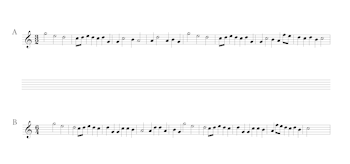
1.4 Part 2 of the book contains five chapters focusing on several aspects of Isaac’s dances: the contexts for which they were composed; his notators and publishers; the music to which his dances were set, much of it apparently composed by Jacques Paisible; and Isaac’s choreographic style, including a useful list of his choice of dance types (pp. 146–48). One of these types, the 3/2-meter hornpipe—familiar from Henry Purcell’s many act tunes and Handel’s Water Music—was used for four of Isaac’s dances or dance sections and was also frequently employed for English country dances from the 1690s to the 1720s. Ex. 1a shows the first strain of one such piece as it appears in Henry Playford’s The Dancing Master (9th ed., 1695), where it is called a “maggot” (a whim or fancy). The hornpipe, unique to England, was completely misunderstood by the French, as can be observed in a 1712 French publication that changed the meter of “Mr. Isaac’s Maggot” to 6/4 and shifted the bar lines one half-note to the left (see Ex. 1b). The result makes no musical sense and is undanceable.
1.5 The inclusion of detailed step descriptions both in this section and elsewhere in the book may leave non-dancers feeling left out, but for readers with some knowledge of Baroque dance technique, these passages are both helpful and thought-provoking. One wishes for an accompanying video that would demonstrate the author’s analyses.
1.6 Readers of JSCM will know that performances of French Baroque dance are readily available online. Ken Pierce and Jennifer Thorp’s article “The Dances in Lully’s Persée” (vol. 10, no.1) includes three videos, danced by the authors; more recently, Rose Pruiksma’s article “Lully on DVD: A Focus on Dance” (vol. 23, no.1) embeds clips from several opera productions (with greater or lesser concern for historical accuracy). In addition, a number of videos of single Pécour choreographies are available on YouTube with good dancing and production values. Alas, the same is not true for Isaac’s choreographies; amateur performances of both the dance and the music do a disservice to our understanding of his works. I hope that this book will encourage more professional dancers to explore and record Mr. Isaac’s creations.
1.7 The book is beautifully produced, and the plates of dance notation are clear and at a size to be readable and useful. A few quibbles: As a compulsive reader of footnotes I am always annoyed at the extra effort required to read endnotes; and although the book is very well documented, the absence of a bibliography is regrettable. Was this a page-saving decision on the part of the publisher to reduce the cost of the book? Perhaps more publishers should consider the practice adopted by Cambridge University Press and others of making supplementary materials available as an online resource. In any case, this book should be considered an indispensable source not only for dance historians but also for musicologists and cultural historians of late seventeenth- and early eighteenth-century England.
[*] Carol G. Marsh (c_marsh@uncg.edu) is Professor Emerita at the University of North Carolina Greensboro, where she taught music history and theory and directed the Collegium Musicum. Since retiring she has continued her research on dance music and notation in late 17th- and early 18th-century England and France.