
The Journal of Seventeenth-Century Music


Positioning the references: References may appear either at the right-hand side or at the foot of the screen. Readers can change the position of the references by changing the width of the window. To change the width, either drag the edge of the window or adjust the magnification (Ctrl+ or Ctrl- on PC, Cmd+ or Cmd- on Macintosh).
Reading the references: Use the note numerals to move back and forth between the main text and the references. The links work in both directions. The linked object will move to the top of its frame.
Opening linked files: In recent issues of JSCM, most examples, figures, and tables, along with their captions, open as overlays, covering the text until they are closed. Nevertheless, readers have choices. In most browsers, by right-clicking the hyperlink (PC or Macintosh) or control-clicking it (Macintosh), you can access a menu that will give you the option of opening the linked file (without its caption) in a new tab, or even in a new window that can be resized and moved at will.
Printing JSCM articles: Use the “print” link on the page or your browser’s print function to open a print dialog for the main text and endnotes. To print a linked file (e.g., an example or figure), either use the “print” command on the overlay or open the item in a new tab (see above).
Items appearing in JSCM may be saved and stored in electronic or paper form and may be shared among individuals for all non-commercial purposes. For a summary of the Journal's open-access license, see the footer to the homepage, https://sscm-jscm.org. Commercial redistribution of an item published in JSCM requires prior, written permission from the Editor-in-Chief, and must include the following information:
This item appeared in the Journal of Seventeenth Century Music (https://sscm-jscm.org/) [volume, no. (year)], under a CC BY-NC-ND license, and it is republished here with permission.
Libraries may archive complete issues or selected articles for public access, in electronic or paper form, so long as no access fee is charged. Exceptions to this requirement must be approved in writing by the Editor-in-Chief of JSCM.
Citations of information published in JSCM should include the paragraph number and the URL. The content of an article in JSCM is stable once it is published (although subsequent communications about it are noted and linked at the end of the original article); therefore, the date of access is optional in a citation.
We offer the following as a model:
Noel O’Regan, “Asprilio Pacelli, Ludovico da Viadana and the Origins of the Roman Concerto Ecclesiastico,” Journal of Seventeenth-Century Music 6, no. 1 (2000): par. 4.3, https://sscm-jscm.org/v6/no1/oregan.html.
Copyright © 1995–2026 Society for Seventeenth-Century Music.
ISSN: 1089-747X
Volume 32 (2026) No. 1
Aquilino Coppini’s Affects and Claudio Monteverdi’s Song: A Book of Contrafacts as a Shared Strategy for Gonzaga Patronage
Michael Carlson*
Abstract
In 1609 Aquilino Coppini dedicated his third and final book of contrafacts to Prince Francesco Gonzaga of Mantua, retexting some of Claudio Monteverdi’s more controversial madrigals with sacred Latin texts. Coppini took a different approach to his contrafacts of Monteverdi’s texts from his earlier contrafacts of other composers’ madrigals, favoring words and concepts that reflected and were enhanced by the affective expression of Monteverdi’s music. The uniqueness of Coppini’s approach is that he drew from Monteverdi’s musical rhetoric to construct new texts while also responding to affective details in the model texts. New biographical context shows that Coppini and Monteverdi cooperated on this book as part of a shared strategy not only to provide a devotional form of “spiritual recreation,” but also as a tool to curry favor and influence for Monteverdi at a tumultuous time in the composer’s career when Francesco was forming his own musical chapel. The dedication also served as part of an effort by Coppini to obtain employment in the young Francesco’s new court.
2. Monteverdi Approaches Coppini
3. Coppini and the Contrafact in Cardinal Borromeo’s Milan
4. Coppini and Monteverdi: The Third Book (1609)
5. From Monteverdi’s Lady to Coppini’s Our Lady: “Una es, o Maria, o speciosa”
1. Introduction
1.1 In May 1609 Aquilino Coppini (d. 1629) published Il terzo libro della musica di Claudio Monteverde … fatta spirituale. The Milanese priest and professor of rhetoric capitalized on the local fame and moderate success he had gained from his two previous books of spiritual contrafacts, issued in 1607 and 1608.[1] These books circulated in a growing Milanese market in the early decades of the seventeenth century that was particularly open to devotional music for spiritual recreation in the wake of the Catholic Reformation. As the titles suggest, the selling feature of the books was their association with Claudio Monteverdi (1567–1643). Monteverdi’s fresh settings of poetry in his Third, Fourth, and Fifth Books of madrigals (Venice: Amadino, 1592, 1603, and 1605) were obvious points of interest to Coppini as a rhetorician, given their vivid emotionality. In the preface to his Second Book of contrafacts (1608), Coppini specifically highlights the expressiveness of Monteverdi’s music, which he calls “rappresentativa” for its vivid representation of the world of the affections:
The representational music of Signore Claudio Monteverdi’s Fifth Book of madrigals, ruled by the voice’s natural expression in moving the affetti, influencing our ears with sweetest maniera, and making a most pleasant tyranny over our souls, is well worthy of being sung and heard not only (as others have said out of spite) in the meadows and among the cattle, but rather in the haunts of the most noble souls, and in royal courts; and it can also serve many as an infallible norm and plan for the harmonious composition of madrigals and canzonas according to the best teaching …[2]
1.2 Clearly Coppini is referring here to Bolognese theorist Giovanni Maria Artusi (ca. 1540–1613), who in 1600 sparked a controversy by criticizing some of Monteverdi’s then unpublished madrigals as offenses to Gioseffo Zarlino’s rules of counterpoint.[3] Though the specific remark disparaging the music as fit only for pastured herds (ne i pascoli, e trà le mandre) has not been found in any of Artusi’s writings, it was presumably contained in his (now lost) rejoinder (under the pseudonym Antonio Braccino da Todi, in 1605 or 1606) to Monteverdi’s response to his attacks. Monteverdi made that brief response in the letter to the readers that opens his Fifth Book (1605); his brother, Giulio Cesare, expanded on it in a “Declaration” inserted in Claudio’s Scherzi musicali (1607). The timing of the Monteverdis’ responses to Artusi, and Monteverdi’s musical publications of 1605 and 1607 themselves, are significant for our understanding of Coppini’s volumes of contrafacts, in view of the serious implications of Artusi’s challenge, which included a veiled accusation of musical heresy, for Artusi dedicated his 1600 treatise to Pompeo Arrigoni, then Cardinal-Prefect of the Roman Inquisition.[4] Monteverdi had placed “Cruda Amarilli, che col nome ancora” at the head of his Fifth Book in defiant response to Artusi’s complaints about its dissonance treatment. The placement of “Felle amaro me potavit populus,” a contrafact of “Cruda Amarilli,” at the opening of his First Book of contrafacts (1607) suggests Coppini’s awareness of Monteverdi’s dispute with Artusi, while bolstering his own ability to “make spiritual” what perhaps might have been seen by some as beyond redemption. By following Monteverdi’s lead, Coppini inserted himself into the ongoing aesthetic debate.
1.3 Indeed, one motivation for Coppini to have highlighted Monteverdi’s music throughout his volumes of contrafacts, in effect defending Monteverdi’s reputation in Milan while demonstrating to the Milanese lettorati his own abilities in spiritualizing erotic madrigals, might have been to capitalize on the notoriety of the dispute as part of his own plans for self-fashioning and career advancement. Coppini, who was overloaded with a very busy teaching schedule at two prestigious schools—the Scuola Palatina, where he succeeded the famous Flemish humanist Hendrik Van den Putte in 1606, and the Collegio Taeggi (Collegium Taegiorum sub invocatione SS. Simonis et Judae)—apparently hoped these publications would lead to better terms of employment. Coppini’s first attempt to angle for a higher academic post coincided with the establishment of Cardinal Federico Borromeo’s most important cultural project, the Biblioteca Ambrosiana. One of the largest public libraries in Europe, the Ambrosiana also came to house Borromeo’s vast private art collection and adjoined the church of S. Sepolcro in the center of Milan. Borromeo’s approval of spiritual contrafacts, as well the cardinal’s own interest in reading across the sacred and profane in the arts, made him an obvious choice of dedicatee for Coppini’s First Book of contrafacts, containing twenty-four settings, eleven of them contrafacts of Monteverdi’s madrigals (the other composers included are Adriano Banchieri, Andrea Gabrieli, Ruggiero Giovannelli, Luca Marenzio, Giovanni Maria Nanino, and Orazio Vecchi).[5]
1.4 The book was meant to showcase Coppini’s rhetorical skill as well as demonstrate his ability to dovetail with Borromeo’s unique brand of Post-Tridentine spirituality (to be discussed below) by drawing upon some of the more controversial of Monteverdi’s madrigals. The volume departed from the usual practice of simply replacing erotic poetry with sacred Latin texts in matching meters. Instead, Coppini used figures of speech to support allegorical readings of the Italian madrigal texts. His contrafacts respond to his models by making thematic and linguistic associations that he often highlights through the use of matching phonemes and homonyms. Coppini’s approach to retexualization is thus the result of a process of literal reading of the model text and “spiritualizing” it by offering meditative corollaries. This allowed him to draw upon a rich constellation of intertextualities that related the contrafact to its model as well as to art and architecture in Milan. Coppini also treats the book as a whole, unifying the contrafacts thematically. In the case of performance in the church, the Passiontide imagery of his texts was meant to work with the artwork and architecture of S. Sepolcro itself, envoicing the affects and experiences of the witnesses to the Passion.[6]
1.5 For Il secondo libro della musica di Claudio Monteverde e d’altri autori a cinque voci (1608),[7] Coppini applied his strategy for patronage by turning to the influential Taverna family of Milan. This volume is dedicated to Suor Bianca Lodovica Taverna, a newly professed Augustinian nun of the convent of S. Marta and daughter of an influential senator of Milan, Matteo Taverna. A fellow member of Coppini’s beloved Accademia degli Inquieti, Matteo died in 1597, leaving his brother, Count Lodovico Taverna, to assume the responsibility for the care of his children. As protector of the convent of S. Marta, Lodovico began a long chain of sending Taverna women to the convent, starting with Bianca in 1607. This volume contains twenty contrafacts, eight of Monteverdi’s madrigals and the rest of works by Giovanni Paolo Cima, Giovanni Croce, Giovanni Pietro Flaccomio, Ruggiero Giovannelli, Luca Marenzio, Claudio Merulo, and Flaminio Tresti. Part of Coppini’s fresh approach to these texts involves intertextualities with convent artwork and the Tavernas’ palazzo, as well as paraphrasing of the convent’s Rule of St. Augustine, demonstrating Coppini’s rhetorical virtuosity and suggesting wider contexts for understanding contrafacts as encoded statements.[8]
1.6 The Third Book of 1609 offers yet a new stage in Coppini’s approach with some significant differences from his previous volumes. Its twenty contrafacts are all of settings by Monteverdi. This distinction matters, as there is evidence to suggest Monteverdi’s editorial hand in the book’s production, from (as we shall see) his involvement in determining the dedicatee to the inclusion of an unpublished madrigal: “Una donna fra le altre,” published later in Monteverdi’s Sixth Book of madrigals (1614). This new madrigal stands at the head of Coppini’s volume with the text “Una es, o Maria, o speciosa.” Part of the draw of spiritual contrafacts involved the retexting of well-worn and widely circulated music, so the addition of an unpublished madrigal presented a novelty. Although Monteverdi’s music takes pride of place in all three of Coppini’s volumes and therefore may have contributed to their marketability, the question arises as to why Monteverdi should have been directly involved in the third one.
1.7 I argue that Coppini’s Third Book is part of a wider strategy of both Monteverdi and Coppini aimed at influencing the heir-apparent of Mantua, Prince Francesco Gonzaga (1586–1612), dedicatee of the volume. The stakes were high for both of them, and Francesco appeared to present a solution for the composer and the academic, who both longed for greener pastures under his employment. The tumultuous circumstances of Monteverdi’s life caused in part by power vacuums in the Mantuan court, by exhaustion, and by personal tragedy have been well chronicled by Roger Bowers and Tim Carter.[9] As Monteverdi’s anxieties vacillated from the terms of his employment or lack thereof, to the hopes of the recently vacated position at the Palatine Basilica of S. Barbara, so too did Coppini attempt to use his contrafacts as a way to escape his precarious professional situation. Coppini’s search for a patron prompted his contrafact project, and his Third Book provided the opportunistic means for Monteverdi and Coppini to assert their value to the young prince who was actively building his court.
1.8 While Coppini’s approach to creating contrafacts for these books varies, it is clear that he treats Monteverdi’s madrigals differently from the rest, given the composer’s tendency to deconstruct Italian texts in ways that challenged Coppini to pay attention to musical rhetoric as well as the poetry itself. The madrigals by the other composers have much more straightforward line-by-line text setting, so this is perhaps not surprising. But Coppini had to contend with Monteverdi’s idiosyncratic approach to poetic texts in the context of the seconda pratica. When he diverts from the syntactical structure of the model text, the diversion is not haphazard but prompted by the musical setting. Coppini reserved Monteverdi’s madrigals for his more serious statements, suggesting that he was a close reader not just of texts, but of music as well. How Coppini listens to Monteverdi, and how this hearing prompts his own poetic choices, are substantive questions calling for a reappraisal of Coppini’s procedure for creating spiritual contrafacts, and an appreciation of the difference between his procedure and the standard practices of his contemporaries, in a time when a proliferation of volumes in this new genre found a significant market in post-Tridentine Milan.[10]
2. Monteverdi Approaches Coppini
2.1 The winter of 1608–1609 was difficult for Monteverdi, then convalescing in Cremona from grief and exhaustion. The composer was recovering from personal loss following the deaths of his wife Claudia (September 1607) and his star pupil, Caterina Martinelli (March 1608).[11] Likewise, he was fatigued from the massive amount of work he contributed to the festivities held in Mantua in May–June 1608 to celebrate the marriage of Francesco Gonzaga to Margherita of Savoy (1589–1655). Monteverdi was not only in ill health, but also increasingly dissatisfied with the terms of his employment with the Gonzagas. Monteverdi’s father, Baldassare, wrote to Duke Vincenzo Gonzaga on 9 November 1608 asking that his son be released from his position in Mantua.[12] Following his father’s appeals to the Duke and Duchess of Mantua, Monteverdi took his concerns to a high-ranking councilor of Vincenzo Gonzaga, Annibale Chieppio, to whom he complained of his low income compared to many other composers, asking him to intercede for an honorable discharge from service.[13] Chieppio’s intercession seems to have been in play, given that nearly a month later, on 19 January 1609, Vincenzo Gonzaga decreed that Monteverdi would receive an annual pension of 100 scudi, increased a week later to 300 scudi.[14]
2.2 Another blow was Monteverdi’s failure to gain the position of maestro di cappella of the Palatine Basilica of S. Barbara following the death of Giovanni Giacomo Gastoldi on 4 January 1609.[15] The position at S. Barbara was ideal for Monteverdi with far fewer obligations, that is, regular weekly services as opposed to the intense peaks of musical activity within the ducal household. Even more troublesome, however, was Prince Francesco Gonzaga and Margherita of Savoy’s impending move to take up residence in Casale Monferrato.[16] The move meant that Francesco would assemble his own group of household musicians, a threatening prospect to Monteverdi who feared he might be replaced when Francesco returned to Mantua to become duke in the event of his father’s death (as indeed came to pass in 1612).[17] Monteverdi was also concerned with the preference the Gonzagas seemed to place on Florentine musicians at Francesco’s wedding festivities through Francesco’s brother Cardinal Ferdinando Gonzaga, and especially the favors given to Marco da Gagliano, “who can hardly be said to have done anything.”[18] In his letter of 24 August 1609 to Alessando Striggio, Monteverdi outlines the business of engaging a wind band and singers for Francesco, most of whom Monteverdi holds in low regard.[19] Fearing that his star was fading in the eyes of Francesco, and given his anxieties for his future, Monteverdi began to make strategic moves to remain in the prince’s good graces.
2.3 One part of Monteverdi’s plan was to serve as a useful broker of musicians for the prince. Another was to publish the score of the favola in musica Orfeo. Francesco had been patron of the first performance of the work, on 24 February 1607 within the Mantuan Accademia degli Invaghiti. Although Orfeo was now two years old, the time had come for Monteverdi to lay his cards on the table by way of his dedication of the score, dated 22 August 1609:
To you, therefore, I humbly consecrate it [Orfeo], so that you who in the manner of a benign star was propitious in her birth, with the most serene rays of your grace, may deign to favor its ongoing life, which I can hope, thanks to Your Highness, may endure to the extent of a human generation.[20]
2.4 In a yet more pointed move, Monteverdi approached Coppini with the idea of a dedication to Francesco. At least, this is what Coppini claims by way of his letter of 26 March 1609 to Pier Francesco Villani in Pavia, through which he shares news of his upcoming book, then in press. Much can be gathered about Coppini—his hopes, desires, struggles—from this letter.[21] Having completed the last of his books of contrafacts, Coppini reveals at least some of his circumstances. Exhausted from his labors of teaching in Milan, he longs for the free time to devote himself to some greater work. By attaching himself to Monteverdi, a decision with its own apparent complications it seems, Coppini was able to signal to potential patrons his capabilities as a writer. But he was bound by obligations and trapped by the glass ceiling that limited him to the role of teaching Latin elocution in multiple schools in Milan:
I am done with major tasks. I have read and edited several speeches of young students of eloquence. What are you looking for? The Third Book containing divine harmonies is in press. I have labored hard on this book, and it seems to me that I have succeeded to some extent in terms of matching with my words the force of the music. I have dedicated it to the Prince of Mantua, to whom I learn that this book would be welcome both for the musical genre and also for the texts devised by me for the task. Claudio Monteverdi has written something on this to me from Mantua.…
Sometimes I myself go around in circles. Everything is wholly curious [to me], which deserves your laughter, and that of any sensible person. I have been filled with a desire to write some history, and excellent subjects present themselves to me. I have not decided anything yet. I am contemplating a wholly great work, which will be welcomed by most in the future, if I am not mistaken. It is my intention to take a middle path between Sallust and Livy, the leading lights of Roman history. In my style, which I see not disapproved of by the learned, I hardly distrust myself over accomplishing something. So far as this is concerned, I need free time, which I am not allowed to enjoy in this College.[22]
Thus, Monteverdi’s opportunistic move to involve Coppini, and the latter’s own hopes for some support from the Mantuan prince, reveal something about the wider system of courtly friendship and the potential functions of contrafacted music in the patronage system of the early seventeenth century.
3. Coppini and the Contrafact in Cardinal Borromeo’s Milan
3.1 Coppini’s contrafact project would perhaps not have been as successful had it not been for his choice to highlight Monteverdi, whose music and choice of texts (largely those of Battista Guarini) were amenable to spiritual readings through allegory. Coppini capitalized on the already growing popularity of published volumes of spiritual contrafacts in Milan at the beginning of the seventeenth century. For the teacher of rhetoric, Monteverdi’s music, in its novelty and fresh approaches to affectivity, were certainly appealing. Given Coppini’s desire to jockey himself favorably for a greater position, either in Milan or beyond, the madrigals of Monteverdi’s Fourth and Fifth Books (1603, 1605), with their own history of controversy, proved to be of great utility to Coppini.
3.2 The details of Coppini’s positions in Milan and elsewhere are often confused, owing mostly to his self-styling in his published books of letters where he identifies himself as a professor of rhetoric at the Ticinensis Gymnasium (University of Pavia), although this was preceded by his positions at the Collegio Taeggi and then, at least from 1606 to 1611, at the Scuola Palatina.[23] His appointments came directly from the Senate, and not the archbishop. But Coppini was an interstitial figure, moving in both ecclesial and secular circles, and able to cultivate an intellectual space supported by Cardinal Federico Borromeo’s sense of Christian optimism. Borromeo’s Milan was a prosperous place for artists and scholars in the rapidly changing world still coping with the Reformations, provided they were willing to navigate these challenges and reconcile themselves with a Catholic Biblical worldview.
3.3 As a secular priest, Coppini was uniquely disposed to embrace Borromeo’s syncretic perspective of contemplating spiritual mysteries from secular imagery. The humanistic education of the young cardinal in the hands of significant patrons of the arts like Cardinal Gabriele Paleotti (1522–1597), and later Cardinal Roberto Bellarmino and Filippo Neri, forged a practical spirituality that embraced the reading of the sacred in the profane. This may be seen in Federico’s manner of viewing painted landscapes and still lifes—secular genres—through a religious lens even when they included no religious symbology, an idea to which he returned throughout his writings, for he found spiritual potency in the natural phenomena themselves.[24] Borromeo placed his commissioned painting (ca. 1595–1606) Canestra di frutta (Basket of Fruit) by Caravaggio (Fig. 1) in a place of honor in the Ambrosiana; it is believed to have been the first still life in his collection. He was fascinated by this work, which he depicts in his Museum as so beautiful, he could find none with which it could be paired.[25] The meticulous rendering of colors and textures apparent in Caravaggio’s basket delighted Borromeo, quite possibly evoking nature in biblical scenes like the Garden of Eden. Yet the fruit in the painting is not perfect. Some leaves are curled and browning, and there are visible wormholes in an apple. This realism suggests the transience of life, the inevitability of decay, and the fleeting nature of life typical in a vanitas piece. The basket is placed on a ledge; the tension of vulnerability from decay and the possibility of falling, made evident through chiaroscuro, points to the likelihood of a particular sort of spiritual reading, such as the prophetic withering of fruit in the story of Amos, the eighth-century prophet writing of social justice and judgment in a time of moral decay. In the passage, Amos is shown a basket of summer fruit as a symbolic vision, representing Israel as ripe for judgment.[26] Pamela Jones observes that Caravaggio’s Canestra “must have appealed to Borromeo as a discrete vision of meditational prayer” and that “Archbishop Federico presumably interpreted the worm-eaten fruit and desiccated leaves in the basket as allusions to the transitory character of God’s earthly gifts.”[27]
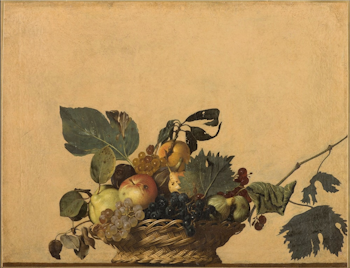
3.4 The contemplative use of naturalistic material is suggestive of Borromeo’s syncretic spiritual methodology. Just as he embraced both religious and secular perspectives in visual art, he encouraged the adaptation of music set to erotic texts with new, spiritual texts, and this became an accepted tradition in Milan. He would have first encountered sacred contrafacts in the Oratory of Filippo Neri in Rome, for prior to his appointment as archbishop of Milan in 1595, he spent his early years as a cardinal in Rome (from 1586). These were formative years as Federico mixed with scholars, theorists, and artists who were crucial to the development of Post-Tridentine culture and who were instrumental in shaping his own approach to sacred art and music.[28] Neri’s Oratory at the Chiesa Nova was a celebrated place of music: oratorio, sacred laude (many of which were contrafacted Florentine texts), and cantatas.[29] As we have seen, in 1607 Coppini dedicated his First Book to Borromeo, in honor of the establishment of the Ambrosiana. In his dedicatory letter, he compares rendering profane music spiritual with the conversion of temples into Christian churches. This was perhaps an attempt to appeal to what he understood as Borromeo’s theology of art.[30]
3.5 Borromeo’s practice of reading across the sacred and profane was taken up by literary societies such as the Accademia degli Inquieti. Founded on 10 June 1594 by Muzio II Sforza Colonna (1576–1622), the academy joined together some of the most illustrious men of letters in Milan, with special attention given to the reading of Dante and Virgil; the emblem of the society was a spinning water wheel or hydraulic machine with the motto “Labor omnibus unus” taken from Virgil’s Georgics.[31] Significant membership included Hendrik Van den Putte as well as some clerics such as Coppini and the Carmelite friar Cherubino Ferrari (ca. 1550–1625). Ferrari’s connection to the Inquieti in Milan and also to Mantua, where he served as Vincenzo Gonzaga’s theologian, makes him an obvious link between Monteverdi and Coppini.[32] Ferrari had contributed two encomia to Monteverdi in the composer’s Fifth Book of madrigals and likewise dedicated published poetic work in honor of Francesco Gonzaga.[33] While in Milan during the summer of 1607, after first performing Orfeo that February, Monteverdi reportedly showed the libretto to Ferrari and perhaps performed the score for him, as documented in a letter dated 22 August 1607 from Ferrari to the Duke of Mantua.[34] The Inquieti context is an important connection between Monteverdi and Milan, and it also seems reasonable to suggest that Ferrari somehow connected Monteverdi with Coppini.[35]
3.6 As we have already observed (par. 1.8), Monteverdi’s idiosyncratic approach to text setting led Coppini to pay attention to the composer’s musical rhetoric along with the rhetoric of the Italian texts. Indeed, what makes Aquilino Coppini’s three books of contrafacts unique is the process he employs to read not only the text but also the music to develop contrafacts that respond to their models. Coppini’s approach to post-Tridentine spiritual recreation was also novel. While prior volumes of contrafacts affix spiritual texts with dogmatic and quasi-liturgical significance, Coppini’s are arranged to make a larger meditative argument that aids in reading his books holistically. Turning away from authoritative dogmatic statements, Coppini’s contrafacts engage with affective spiritual responses that appear to be designed to move the listener towards devotion.[36] Coppini thus presents a highly syncretic process of reading across texts that is closely associated with Borromeo’s own process for spiritually reading art, allegorizing and adapting erotic poetry for affective spiritual expressions and devotional use. As a rhetorician, Coppini crafted Latin poetry that closely responded to the thematic significances in his models, resulting in contrafacts that serve as integral responses to the texts originally set by Monteverdi, and to Monteverdi’s music as well. From a religious perspective, Coppini’s rewriting may be understood as an improvement: the perfection of all human activity finds its fulfillment only in the praise of God (Colossians 3:23–24). As Ehrmann-Herfort puts it, Coppini saw his contrafacts as a kind of purification (Läuterung) of pieces whose music he admired, in the service of restoring public consciousness to a cohesive, spiritually and religiously determined worldview.[37]
4. Coppini and Monteverdi: The Third Book (1609)
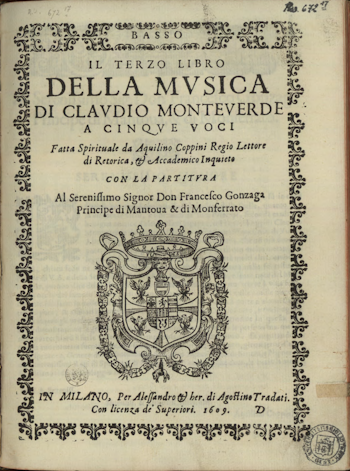
4.1 No complete set of partbooks for the Third Book survives, but there are enough individual partbooks and manuscript copies to reconstruct its contents, summarized in Table 1.[38] Of printed partbooks, the Basso is in Ghent at the Universiteitsbibliotheek,[39] while the Alto and Tenore parts are held in the Archivio Musicale del Duomo of Como. The Bischöfliche Zentralbibliothek, Proskesche Musikabteilung, Regensburg (A.R. 964–984) contains manuscript copies of all the partbooks save the Alto (as in the case of the portions of the Second Book preserved there). The partitura (score) noted on the title page (Fig. 2) is lost. Between his three books, Coppini reworked all of Monteverdi’s Fourth and Fifth Books except for four madrigals: “Ohimè, se tanto amate” (Fourth Book, no. 11), “Non più guerra, pietate” (Fourth Book, no. 14), the six-voice “E così a poco a poco” (Fifth Book, no. 12), and the nine-voice “Questi vaghi concenti” (Fifth Book, no. 13). The last two can presumably be ruled out because of their scoring, but the two from the Fourth Book were perhaps being saved for the future or simply did not lend themselves to setting as contrafacts.
4.2 The Third Book has two prefatory poems by Giovanni Soranzo,[40] a Venetian poet who arrived in Milan in 1606, thanks to the intercession of the Inquieto academician Orazio Seroni; taking advantage of the celebrations for the birth of the Prince of Spain, Filippo Domenico Vittorio, Soranzo drew the attention of the eccentric Count of Sale, Francesco d’Adda (1571–1644).[41] The first of Soranzo’s poems is indicative of the nature of contrafacts in general as transformative works. Yet Ehrmann-Herfort cites this poem as specific to Coppini’s approach, for its reference to transforming the worldly into the divine by strengthening and refining the passions.[42]
Con l’ale di colomba sopra i venti
t’alzi da terra, e fermi
nel vero sole il lume:
e qual serba costume
L’AQUILA i mal pennuti parti infermi
provando, tal gli affetti
in Dio mirando sì ben tempri, e affini,
che gli fai di terreni esser divini.
E accoppiando al numero i bei detti
fai canoro, e fiorito un MONTE, e VERDE
sì, che appo lui ne perde
poi Primavera il pregio;
virtù del tuo gran stil, COPPINI egregio.(With dovelike wings you rise from the earth, riding the winds, and fix your eyes on the true sun; and just as the EAGLE stays true to her nature by toughening her scantily feathered offspring, you, looking to God, strengthen and refine the passions so well that you transform them from worldly to divine. And by matching fine words to musical proportions, you make a MOUNTAIN melodious, floral, and GREEN, so that next to it, spring pales in comparison: by virtue of your great style, illustrious COPPINI.)
4.3 The significance of Coppini’s achievement seemed noteworthy to this fellow Inquieto. The obvious and typical wordplay aside—with Monteverdi as “a mountain green” and Aquilino Coppini as a mother eagle—Soranzo sums up well the two most important aspects of the Third Book with respect to the present study: that Coppini’s project involved more than replacing words with matching spiritual meanings, and that this process was most likely not divorced from the work of the composer. In other words, to contrafact Monteverdi meant becoming a good reader of his music, a process that developed and was perfected throughout Coppini’s project. We shall see below that the book’s first sonnet is revelatory of the process by which Coppini endeavors to match music with contemplative insights that foster spiritual readings. Significantly, Soranzo’s “green mountain” wordplay, while amusing, also suggests the nature and significance of Coppini’s poetic work: to spiritualize music in the same way that the mountain repeatedly represents a place of divine encounter in the Scriptures (e.g., Moses and the Ten Commandments, Elijiah confronting the prophets of Baal on Mt. Sinai, and Jesus’s Transfiguration at Mt. Tabor).[43] Turning green therefore suggests an act of divine transformation and spiritual rebirth. Essentially, “turning a mountain floral and green” is a poetic image of God’s transformative power, bringing new life and spiritual flourishing to a place of great significance, in this case making worldly things (madrigals) divine (motets).
4.4 Soranzo’s second poem speaks of the two, poet and composer, being of one heart; if Soranzo’s poetry can be taken literally, the relationship between Coppini and Monteverdi must have been close. But more importantly, Soranzo gives a clue as to how he—and perhaps Coppini with whom he had a long history of correspondence, both through letters and in epigrammatic verse—understands the role of Coppini’s words in supplying the transformed affetti to Monteverdi’s music.
O quanto hà forza amore.
Duo fidi amici, e cari hanno un sol core.
Accompagnato i detti,
accompagnan gli affetti
co’ le note canore
co’ le voci sonore.
Felice compagnia:
l’uno vive per l’altro.
In gentil modo, e scaltro
dà senso l’armonia
a i detti, e i detti sono
poi l’anima del numero, e del suono.
Chiedi, chi può mai tanto?
Gli affetti d’AQUILIN, di CLAUDIO il canto.(O how much strength has love. Two faithful, dear friends have a single heart. Having accompanied the words, they accompany the affects with songful notes, with resounding words. Happy partnership: the one lives for the other. In sweet and cunning fashion the harmony gives sense to the words, and the words are then the soul of the musical proportions, and of the sound. Ask yourself: Who can ever do so much? The affects of AQUILINO, of CLAUDIO the song.)
4.5 Coppini’s dedication of his Third Book to Francesco Gonzaga (dated 4 May 1609) is also worth reading in detail. It begins with Coppini arguing that the greatness of Mantua does not come from the stars—some external, cosmic, or even spiritual fortune—but from within: by the virtue of her rulers. He draws upon the precepts of epideictic rhetoric to centralize virtue in his words of praise—as does Monteverdi in his own dedication of Orfeo to the prince—to advocate a type of virtue-politics that becomes prevalent throughout the Baroque.[44] By highlighting the virtue of liberality, or generosity, they press upon Francesco’s obligation to his subjects and to the world at large:
The most ancient and most beautiful city of Mantua was at all times not so much due to the particular influence of the stars, but for the eminent virtue and liberality of her princes, the fecund mother and kindly nurse of the most elevated intellects, among which today Claudio Monteverde, dedicated to the service of Your Highness’s most serene house, has reached in music such excellence that those musical effects which we read with great wonder in ancient books should no longer appear strange. Of this, among many other works, clear evidence is given by Arianna, a work which, staged at the most-happy wedding of Your Highness and the Most Serene Infanta of Savoy, with Monteverdi’s new and suave notes, not to speak of the expression of other affections, was able to draw with living force from the eyes of the famous audience and of whomever heard it, thousands upon thousands of pitying tears.[45]
Coppini continues directly to push matters even further by reminding Francesco of the music Monteverdi had composed for the Mantuan wedding festivities of the previous year. Musicologists have explored well the music for the festivities in Mantua celebrating the wedding of Francesco Gonzaga and Margherita of Savoy (which had been celebrated in Turin on 19 February 1608). Monteverdi’s musical contribution to this dynastic celebration is emphasized in Coppini’s dedicatory letter as he recalls the celebrated (though now mostly lost) opera Arianna, staged in Mantua on 28 May 1608. Arianna’s lament, performed by Virginia Ramponi-Andreini, was famously described by Federico Follino to have been so powerful that “there was not one lady who failed to shed some little tear,” a detail Coppini echoes in this dedication to Gonzaga with his “a mille a mille pietose lagrime.” Coppini wastes no time in drawing Monteverdi to Francesco’s attention, also suggesting the composer’s prominence beyond Mantua itself.
4.6 Cherubino Ferrari also jumped on the bandwagon. Just days after the date of Coppini’s dedication, Ferrari wrote to Prince Francesco in Casale Monferrato (13 May 1609).[46] Always an opportunist, Ferrari takes credit for Coppini’s dedication to the prince. He apologizes to the prince for being detained in Milan at the request of Cardinal Borromeo, but now that Ferrari is free, he begs Gonzaga for some work and for the favor to intercede on his behalf with the Archbishop of Turin to engage Ferrari’s services to preach the following Lent (a request Francesco Gonzaga could presumably pursue through his father-in-law, Carlo Emanuele). These requests are couched in typical flattery, as when Ferrari, as teologo, famously sang the praises of Monteverdi’s Orfeo, only to immediately ask for more work (Lenten preaching) in Mantua.[47] But Ferrari also takes credit for inspiring “Aquilino” to dedicate some “madrigals changed into motets” to Francesco’s glorious name, to which Ferrari will soon add some of his own works (which he later did in the form of orations). In an earlier letter (20 June 1607), Ferrari noted some biographical points that are relevant to contextualizing his relationship with Coppini. In that letter, addressed to the Mantuan court, he identified his monastery as S. Giovanni in Conca, neighboring Marchese Caravaggio’s palazzo where the Inquieti met. He told Vincenzo Gonzaga of his apartment in the rectory of S. Stefano Maggiore and his willingness to offer lodging in Milan to anyone Duke Francesco might want—as he had already done for two Cremonesi—including Gonzaga himself (if traveling incognito).[48]
4.7 With his Third Book, however, Coppini was doing more than just supporting Monteverdi. He also sought some benefit for himself. After Ferrari’s letter to the prince reintroduced Coppini’s name to Francesco Gonzaga—Ferrari identifies him only by first name—Coppini followed up with his cover letter to the prince a month later (6 June 1609), sending a copy of his book.[49] Again, Coppini speaks of the composer in his letter, noting how he has drawn out “affections from Monteverdi’s vibrant music” which, he believes, the prince has heard on more than one occasion. Coppini’s wording that he has “drawn out” the affections of Monteverdi’s music—cavato has the connotation of mining or excavation—is significant, suggesting that Monteverdi’s music contains affections, but they needed drawing out by way of spiritual texts. This is no small point; Coppini is clearly responding to a Thomistic understanding of the passions needing to be ordered to the Good, as was hotly debated by Reformist theologians.[50] By demonstrating his fluid ability to navigate the sacred and secular in an erudite fashion, Coppini not only presents his value to Francesco but he becomes more direct in what he expects from this relationship. While starting from a book of sacred contrafacts, he prods on for yet more work: “I have hoped to be able to acquire your longed-for grace. If I obtain it from the innate kindness of such a great prince, I will consider myself extremely fortunate, and in time, I will be able to reveal my devotion to your most glorious family in a different way in some other greater work, which I am mulling over day by day, concerning most noble history.”
4.8 Coppini is promising to follow up his dedication with something “different” and “greater,” which seems to be a history of the Gonzagas. Coppini expresses in 1609 a certain anxiety over some “greater” and more important work, and as such, his motivations become evident. He envisions himself working on bigger projects that he currently cannot accomplish because of his teaching obligations in Milan at both the Palatina and the Taeggi, as he had already written to Pier Francesco Villani just over two months earlier. He also hints at this desire while sending his books of contrafacts to Hendrik Van den Putte in July, noting in particular Monteverdi’s music having “a truly wonderous capacity for moving the affections,” and even offering more should he want them. Turning to practical matters of employment in that letter to Van den Putte, Coppini claims that he is also looking for things better suited to his institutional responsibilities.[51] Through his contrafact books, Coppini sought to demonstrate his talent and capabilities to potential patrons, perhaps with aspirations for the freedom to write his own projects.
5. From Monteverdi’s Lady to Coppini’s Our Lady: “Una es, o Maria, o speciosa”
5.1 Opening Coppini’s Third Book is “Una es, o Maria, o speciosa,” a contrafact of “Una donna fra l’altre honesta e bella,” which Monteverdi would later publish in his Sixth Book of 1614. My transcription of the music (with the original Italian text accompanying Coppini’s Latin in the underlay) is provided in the Appendix.[52] The presence of this as yet unpublished piece in Coppini’s book is strong evidence of Monteverdi’s involvement and was perhaps a strong selling point for the Milanese market, as well as a factor in raising the value of the collection for Francesco. Yet it created an unusual set of problems for Coppini precisely because it was a madrigal for voices and basso continuo (as also was no. 2 in Coppini’s 1609 volume, “Amor, se giusto sei”), meaning that the text was not presented equally by all five voices in a standard polyphonic texture.
5.2 The poem, by an unknown author, is a thrilling narrative sonnet about a woman—beautiful beyond all others—who is as dangerous as she is fair. The tercets are particularly evocative of her erotic power:
(A woman among others honest and beautiful / I saw in the chorus of adorned beauty; / her weapons shook as she walked about, / love’s attacker and rebel. // From her fair face shot golden arrows / and in that night, causing envy and shame, / she made it bright as day with the sun of her beautiful eyes; / she rendered every watching soul her servant. // She did not take one step that did not wound, / nor ever batted an eyelash that healed, / nor was there a heart that escaped her wounds. // She did not wound anyone who yearned to heal, / nor was anyone healed who languished, / nor did anyone languish until she loved him.)
(You are one, o Mary, o beautiful / Virgin, who surpasses the pure lilies, / and you glow in red and in purple color / brighter than the golden splendor of the Sun. // You gave birth, Virgin, to the propitious light / on that exceedingly fortunate night, / which in radiant white brightness / illuminated the fleeing shadows. // You broke the heads of the dragon, / and mercifully you healed our wounds. / You are powerful, you have wounded death. // You triumph in your humility, / you are sweet to protect us from languishing, / now you, o blessed one, reign in glory.)
5.3 Monteverdi’s concertato setting of this text distributes the poem between the three lower voices (TTB) for the first quatrain (mm. 1–23), and the two upper ones (SS) for the second (mm. 24–43), bringing them together for the sestet (mm. 44–60 and 61–77).[53] The “weapons” used by the woman to attract her lovers are represented by a dotted-rhythm melisma creating bouncing and shaking text-painting on vibrar.[54] Monteverdi deconstructs the poetic rhetoric in the first quatrain by repeating line 4, “feritrice d’amor, d’amor rubella,” five times, thereby highlighting the perilous nature of the poetic subject. However, in the second quatrain he repeats a portion of line 8 only twice, creating a slight imbalance in the setting. More problematic for Coppini is Monteverdi’s treatment of the first line of the text, which cadences on vidi and not bella, as Monteverdi extends the first phrase into line 2 of the text (mm. 6–8); in m. 8 T1’s statement of the second phrase overlaps the cadence in T2. While it makes grammatical sense, Monteverdi’s fourteen-syllable phrase forces Coppini to be a close reader of the musical rhetoric as he develops a new spiritual text. Monteverdi’s setting respects the enjambment on “vidi”; Coppini does the same by completing the vocative at the beginning of line 2. T1’s echo-like entry on “vidi” in Monteverdi’s setting emphasizes the one and only moment of first person in the narrative, whereas the entry on “Virgo” in Coppini’s emphasizes the address to the Blessed Mother. Note that Coppini retains many of the model’s vowels, as shown here in italics:
| U- | na | es, | o | Ma– | ri- | a, | o | spe– | ci- | o- | sa | Vir- | go, |
| U- | na | don- | na | fra | l’al- | tre | ho– | ne– | sta e | bel- | la | vi– | di, |
5.4 Here Coppini reverses Monteverdi’s woman who wounds, turning her into the Blessed Virgin Mary, the woman who heals;[55] and in the second quatrain, Monteverdi’s dangerous erotic night becomes the night of Christ’s birth. The Latin text draws upon a typology that, while ethereal, is of course quite common: Mary as the Blessed Mother. Coppini’s contrafact is replete with Marian imagery, such as splendid light, lilies, the golden Sun, and a reference to Revelation 12:1–4, a portrayal of the symbolic conflict between Evil and the Church, as represented by a dragon (Satan) pursuing a pregnant woman (Mary).[56] Christine Getz notes that in the sixteenth century this Revelation text was frequently interpreted as referring prophetically both to the Virgin’s fecundity and to the Immaculate Conception.[57] Themes of birth and divine protection are seen as foundational to Catholic Mariological texts, which understand this biblical passage as pivotal for anchoring affirmation of the veneration of the Virgin. The Cult of the Madonna del Parto (Madonna of Childbirth), a veneration of pregnancy and motherhood that originated in the fourteenth century (as a way to encourage lactation), centered on images of the pregnant Virgin or of Mary and the infant Jesus, and on relevant private and public devotional spaces. Milan in Coppini’s time saw collections of music meant to honor expectant and new mothers, such as the spiritual madrigal collection of the Milanese maestro of Santa Maria alla Scalla, Orfeo Vecchi (ca. 1551–1603), La donna vestita di sole (1602).[58]
5.5 Naturally, Coppini’s desire to appeal to Francesco Gonzaga might lead him to open his book with an invocation of the Madonna del Parto: the reference to fecundity, spiritual and physical, was appropriate to the young prince immediately following his nuptials to Margherita of Savoy, who would give birth to their oldest and only surviving child, Maria (1609–1660), in July. The language of Coppini’s letter of dedication to Francesco (see par. 4.5) is replete with maternal overtones, such as his reference to Mantua as “fecund mother and kindly nurse” as well as to the recent wedding supported by Monteverdi’s music. It is not a stretch to consider that Coppini would want to associate Francesco’s first child, perhaps a desired male heir to the House of Gonzaga, with such an august lineage as the fruit of Mary’s womb. Perhaps more than mere prescribed flattery, “Una es” is a pointedly strategic blessing from a cleric seeking favors. The association of Monteverdi’s music with the harmonious union of the couple and then the consequence of that union in childbirth might be wishful thinking, but it is not without precedent that subjects would be involved in the amorous lives of their patrons through artistic means. Nothing was more concerning for the livelihood and security of the entire court than the stability that came with producing a male heir. As part of a shared strategy to influence Francesco, the reminder of Monteverdi’s supposedly happy association with the prince’s marital life would theoretically be a safe move for Coppini.
5.6 As mentioned above (par. 1.3–5), Coppini’s earlier books of contrafacts each focused on a single theme, represented in the dedication, and that theme, moreover, was related to a physical space: Borromeo’s Biblioteca Ambrosiana for the First Book and the convent of S. Marta for the Second.[59] For example, his First Book of contrafacts was created around the time of the celebrations commemorating the opening of the Biblioteca Ambrosiana, and its texts, focusing on the Crucifixion, seem to be connected to the physical space that the library would come to occupy alongside the church of S. Sepolcro—significant both in its connection to the Holy Sepulcher in Jerusalem and as a prominent burial site for Milan’s elite, and in the words of Borromeo, “in media civitate constructa, quasi Umbilicus iacet” (having been built in the center of the city, it is, so to speak, its navel).[60]
5.7 For his Third Book, I suggest that Coppini’s construction of musical space in “Una es, o Maria, o speciosa Virgo” ties Monteverdi’s music to the sacred space of the Gonzaga’s basilica in Mantua, the Palatine Basilica of Santa Barbara. Following the logic of Coppini’s published dedication, as well as his private cover letter to the prince, the main arguments of the Third Book were to manifest Monteverdi’s powerful music to his listeners in a new way, and also to encourage Francesco to associate Monteverdi’s madrigal music with sacred as well as secular space. To accomplish the latter, Coppini seems to fashion his opening contrafact text so that it refers closely to the most prominent artwork in S. Barbara, that is, the Marian panels attached to the famous organ built by Graziadio Antegnati. They were thought to have been painted by Lorenzo da Costa the Younger, but many scholars now consider them to be the work of Fermo Ghisoni (da Caravaggio, 1505–1575), a student of Lorenzo Costa the Elder.[61] The instrument in the church was—and continues to be—of considerable fame, constructed by the distinguished Brescian organ builder largely in the summer of 1565.[62] In 1572, paintings in the form of shutters were added. When closed they show depictions of Saints Barbara and Peter, and when opened, a scene of the Annunciation—the angel Gabriel delivering the news to the Virgin Mary that she has found favor with God and will bear a child (Luke 1:28–38). See Fig. 3.[63] With regard to the closed shutters, it is noteworthy that Coppini’s Third Book includes two contrafacts referring to saints, one of them Peter and the other an unnamed martyr (probably not Barbara as there is no hagiographic indications suggesting her), a departure from his other poetic choices throughout the three volumes of contrafacts.[64] As for the open shutters, here I propose an intertextuality between the painted Annunciation scene and Coppini’s “Una es.” While there is no record of Coppini ever visiting Mantua, Ferrari could have relayed particular details of the painting to him. In any case, apart from the figures of Abraham and Isaac, the imagery to be discussed here is common to Annunciation scenes in general. Coppini presumably hoped his poetry might be suggestive to his dedicatee, Prince Francesco, who knew the painted shutters well.
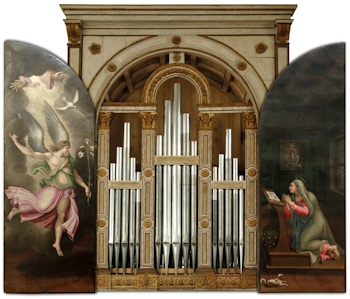
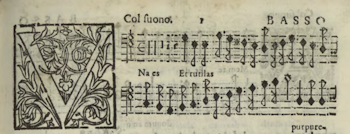
5.8 Coppini’s contrafact (see the score in the Appendix) is consistent with Annunciation imagery. The first quatrain, which Monteverdi sets in the male poetic voice (TTB), is the voice of God, depicted in the painting as the Trinity (mainly on the left panel): God the Father with hands outstretched from Heaven, and God the Spirit as the dove descending, with a line pointing to the figure of the Virgin Mary in the lower right-hand panel, where God the Son is within her womb. Coppini uses each phrase to reflect a “word” from the Triune God.[65] His text reflects the concept of Oneness in the vocative address to Mary, “Una es, o Maria” (Tenor 2).Tenor 1 sings of Mary surpassing the lilies, such as those in the archangel Gabriel’s outstretched hand (left panel). The image of the lily is also presented in Tradate’s woodblock capital (Fig. 4). The Bass joins Tenor 1 for the melisma on et rutilas; vibrar in Monteverdi’s setting depicted the shaking of the woman’s “weapons,” and now it references the “vibrant” red and purple colors associated with Marian iconography.[66] Coppini’s text speaks of Mary glowing in red and blue (purpureo meaning darkish blue or purple); here the painter depicts her in a red garment, kneeling and receiving the Word. The three male voices then join together to sing of Mary’s glory, brighter than the splendor of the Sun, a clear reference to “the woman clothed with the Sun” in John’s Apocalypse (Revelation 12:1).
5.9 Monteverdi set the second quatrain for two sopranos. In Coppini’s version the high, sweet parallel thirds are perhaps meant to evoke angels in heaven (who are represented in the Annunciation by Gabriel). The second and third lines (starting in mm. 26–27: Monteverdi’s “e’n quella notte,” Coppini’s “in illa nocte”) are stated three times, during which parallel thirds lead to a more complicated, imitative setting, which is followed by a return to parallel thirds. Monteverdi’s “notte” makes grammatical closure (and he even sets it twice as a cadence); Coppini apparently liked keeping that word so much that he didn’t mind separating it musically from its adjective, “fortunata.” And while Monteverdi respects the poetic rhetoric by setting line 8 after a cadence and rest (m. 38), Coppini chooses enjambment, allowing for a creative text-painting device that portrays light from above descending and scattering the shadows (mm. 39–43). The painting portrays Mary in a darkened room full of shadows (it is night)[67] where she is clearly the source of light, a detail made more concrete by the presence of a window that allows moonlight in: the corners of the ceiling are illuminated by her, and not by light from outside. Coppini also alludes in this quatrain to the Christmas scene, which happens at night, an image he will return to later in the book with his “Rutilante in nocte” (no. 19), a reworking of Battista Guarini’s Arcadian poetry in “Io mi son giovinetta.” Nighttime scenes, especially those of celestial imagery, factor significantly throughout the book.
5.10 While the contrafact’s octet is about the Annunciation, the sestet is about the broader consequences of the event. The first tercet in Coppini’s version begins with the curious phrase “Tu confregisti capita draconis” (You broke the heads of the dragon). Coppini may have been drawing on theological imagery of Mary in relation to Revelation, which he had previously done in selected contrafacts in his First Book.[68] (See above, par. 5.4.) However, in Ghisoni’s panel (Fig. 3) there is a telling detail to which Coppini may have been responding: the framed image of the sacrifice of Abraham and Isaac on the wall just above Mary’s head. The image of Abraham is important in Marian typology, as Abraham is a biblical archetype for responding in faith to God, a point reinforced by the image of the small dog at Mary’s feet, a common symbol in the Renaissance for fidelity or loyalty. In his letter to the Roman nobleman Oceanus (397 CE), St. Jerome invokes the image of water as a punishment for “sinful peoples” by referencing the destruction of Pharaoh in the Red Sea and citing the relevant Psalm (73:13–14): “you broke the heads of the dragons in the waters, you broke the heads of leviathan in pieces.”[69] For Jerome, while Abraham and Isaac were prevented by the Philistines from digging wells in a time of famine (Genesis 26:12–33), faithfully following God’s command, even though it might be confusing, was a source of life for Israel.[70] A simpler interpretation: “You broke the heads of the dragon” can be understood as “you conquered the terrors of death” (tu vulnerasti mortem), thus as a powerful metaphor for Christ’s victory over evil, with the dragon as a biblical symbol for the forces of chaos and evil.[71] As such, the picture of Abraham and Isaac in the Annunciation scene illustrates another way of conquering the horrors of death—the substitution of the lamb for human sacrifice. In his contrafact, Coppini might have meant to connect Mary to the ideas of fidelity and sacrifice represented by the Old Testament image present in the panel.
5.11 Coppini does not precisely follow the rhetoric of his model to create his version of the sestet. The model text presents each tercet as a sentence, each with the formula Non … ne … ne (No … nor … nor). Part of what makes the model so satisfying is the parallel structure with shared rhyme scheme. Coppini does have a single clause for each line (each with a “you” verb), all but one (line 10) beginning with “Tu.” Monteverdi sets the first tercet in a way that breaks up the structure of the text: two simple statements followed by more elaborate voicing. That is, “Non diede passo all’hor che non ferisce,” is presented once by TTB; the outer voices, SSB, then state the next line, “Ne girò ciglio mai che non sanasce”; the final line, “ne vi fu cor che ’l suo ferir fugisce,” is presented with a polyphonic statement in all voices, repeating the text eight times and making that line more emphatic. This works well for Coppini’s retexting, with emphasis on the Virgin’s power.
5.12 The final tercet is given a more balanced presentation by Monteverdi, prompting Coppini to follow the syntax of the model more directly, replacing Non … ne … ne … with Tu … tu … tu … Ultimately, Monteverdi’s setting of the model text allows Coppini to introduce implications for princely leadership. Since Coppini singles out Francesco’s princely virtue, namely his generosity (liberalità), in the dedication at the head of the book, it appears that in the contrafact he seeks to press the point by magnifying the spiritual consequences for a generous ruler: a glorious reign. Though “tu regnas” refers to the Blessed Virgin Mary, the repetitions in all the voices from m. 66 to the end might have been meant to speak directly to the young prince, in the hope that he would draw upon Mary as a model for human (and not just feminine) behavior.
6. Conclusion
6.1 When sending his three books to Hendrik Van den Putte, Coppini perhaps realized that this would be his last book of contrafacts, even though he offered more should Van den Putte wish it. Regardless of whatever hopes and aspirations he may have placed in creating them, even if these were not realized immediately, Coppini may have felt in the end that contrafacts were not very useful in professional terms. He stopped publishing them, only to find that some of his contrafacts—including “Una es, o Maria”—would be reset as motet texts in their own right within Milanese circles, by Giovanni Ghizzolo, Domenico Rognoni, and Giovanni Valentini.[72] In the end, there is no record of Coppini’s “greater work,” no record of him writing any sort of history; the literary histories of Milan remember him only because of his contrafacts. On Monteverdi’s part, by the time of the publication of the Third Book, Stefano Nascimbeni had officially replaced Gastoldi as maestro di cappella at S. Barbara, holding the office following a brief pro tempore period with Antonio Taroni in charge. (Nascimbeni would leave S. Barbara in late August 1612.[73]) In the time leading to press, however, there was still hope that Monteverdi could replace Gastoldi. In the end, their shared strategy failed. Francesco would not succeed his father for some time. Neither Monteverdi nor Coppini served Francesco in Casale Monferrato or in Mantua. Following Vincenzo Gonzaga’s death in 1612, Francesco became duke, but he died suddenly some nine months later. He had fired Monteverdi and his brother Giulio Cesare only a month after his own coronation. Though it took some years, Monteverdi and Coppini eventually went on to more agreeable positions outside Mantua: the former to St. Mark’s Basilica in Venice (1613) and the latter to the University of Pavia (also in 1613).
6.2 Nevertheless, as the culmination of an artistic project, Coppini’s Third Book offers many insights on his listening and music-reading practices as an amateur musician. Most significantly, his erudite approach to madrigal contrafacts provides new context for rethinking the value and purpose of these collections. As Soranzo suggests in his first epigram to the Third Book, Coppini’s approach did far more than replace erotic poetry with sacred verses; rather, Coppini made “a mountain melodious, floral, and green.” The wordplay on Monteverdi’s name aside, Soranzo sums up well the important point that Coppini was not divorced from the work of the composer. To contrafact Monteverdi meant becoming a good reader of his music, a process that Coppini developed and perfected throughout his project. In his labors over reading the affections contained in Monteverdi’s music, Coppini’s attempts to draw them out—to strengthen and refine them, as Soranzo says—might have been precisely what he meant in claiming to make the music spiritual. In dedicating the book to Francesco, Coppini surely hoped that this spiritual rhetoric might impress on the young prince a sense of moral duty to take care of his subjects.
Acknowledgments
Many thanks to Tim Carter, Annegret Fauser, Roseen Giles, Andrea Bohman, and Maggie Fritz-Morkin for advising the doctoral research that this article elaborates. Thank you to my colleagues at the University of Notre Dame, Texas A&M University at Kingsville, The University of North Carolina at Chapel Hill, and Duke University for sharing their insights and support on this project. Versions of this essay were read at the 20th Biennial International Conference on Baroque Music at the Haute Ecole de Musique de Genève-Neuchâtel, Switzerland, and the 89th Annual Meeting of the American Musicological Society held in Denver, CO. Thank you for the generosity of The Renaissance Society of America and both the Music Department and the Program in Medieval and Early Modern Studies at UNC-CH for their generous support of this research through grants and fellowships. I am indebted to the anonymous reviewers and editor of this Journal for their helpful feedback leading to the final product.
Appendices
Appendix. Score of “Una es, o Maria, o speciosa” from Coppini’s Third Book (no. 1)
Figures
Fig. 1. Michelangelo Merisi da Caravaggio, Canestra di frutta (ca. 1599), oil on canvas, 46 cm x 64.5 cm. Biblioteca Ambrosiana, Milan.
Fig. 2. Coppini, Third Book, Basso partbook, title page. Universiteitsbibliotheek, Ghent.
Fig. 3. Organ by Graziadio Antegnati (1565), with opened panel depicting The Annunciation by Fermo Ghisoni (1572). Basilica Palatina di S. Barbara, Mantua.
Fig. 4. Coppini, Third Book, Basso partbook, fol. 2 (detail), depicting the printer Tradate’s lily-gilded capital. Universiteitsbibliotheek, Ghent.
Tables
Table 1. Contents of Coppini’s Third Book