
The Journal of Seventeenth-Century Music


Positioning the references: References may appear either at the right-hand side or at the foot of the screen. Readers can change the position of the references by changing the width of the window. To change the width, either drag the edge of the window or adjust the magnification (Ctrl+ or Ctrl- on PC, Cmd+ or Cmd- on Macintosh).
Reading the references: Use the note numerals to move back and forth between the main text and the references. The links work in both directions. The linked object will move to the top of its frame.
Opening linked files: In recent issues of JSCM, most examples, figures, and tables, along with their captions, open as overlays, covering the text until they are closed. Nevertheless, readers have choices. In most browsers, by right-clicking the hyperlink (PC or Macintosh) or control-clicking it (Macintosh), you can access a menu that will give you the option of opening the linked file (without its caption) in a new tab, or even in a new window that can be resized and moved at will.
Printing JSCM articles: Use the “print” link on the page or your browser’s print function to open a print dialog for the main text and endnotes. To print a linked file (e.g., an example or figure), either use the “print” command on the overlay or open the item in a new tab (see above).
Items appearing in JSCM may be saved and stored in electronic or paper form and may be shared among individuals for all non-commercial purposes. For a summary of the Journal's open-access license, see the footer to the homepage, https://sscm-jscm.org. Commercial redistribution of an item published in JSCM requires prior, written permission from the Editor-in-Chief, and must include the following information:
This item appeared in the Journal of Seventeenth Century Music (https://sscm-jscm.org/) [volume, no. (year)], under a CC BY-NC-ND license, and it is republished here with permission.
Libraries may archive complete issues or selected articles for public access, in electronic or paper form, so long as no access fee is charged. Exceptions to this requirement must be approved in writing by the Editor-in-Chief of JSCM.
Citations of information published in JSCM should include the paragraph number and the URL. The content of an article in JSCM is stable once it is published (although subsequent communications about it are noted and linked at the end of the original article); therefore, the date of access is optional in a citation.
We offer the following as a model:
Noel O’Regan, “Asprilio Pacelli, Ludovico da Viadana and the Origins of the Roman Concerto Ecclesiastico,” Journal of Seventeenth-Century Music 6, no. 1 (2000): par. 4.3, https://sscm-jscm.org/v6/no1/oregan.html.
Copyright © 1995–2026 Society for Seventeenth-Century Music.
ISSN: 1089-747X
Volume 32 (2026) No. 1
“This Old Opera”:
Francesco Cavalli’s House on the Grand Canal
Jennifer Williams Brown*
Abstract
Archival documents make it possible to identify the house on the Grand Canal in Venice where Francesco Cavalli lived and worked from ca. 1646 until his death in 1676. The composer’s will and the inventory of his possessions after his death permit us to reconstruct his apartment there and his other dwellings; musical documents allow us to imagine the work of composing and revising operas that took place there. The building on the Grand Canal has undergone obvious reconstruction since Cavalli inhabited it. A metaphorical analogy may be drawn between architectural changes over the years and Cavalli’s construction and reconstruction of his operatic scores. Both the history of architecture and the history of opera reveal competing human impulses: the urge to adapt and the urge to preserve.
2. Identifying Cavalli’s House
3. Inside Cavalli’s House: Primo Piano Nobile
8. Epilogue: Architectural Parallels
1. Introduction
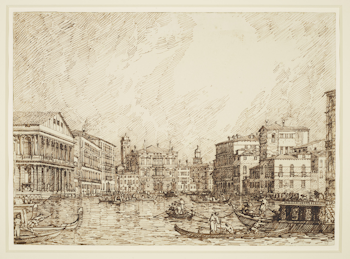
1.1 As you come around the bend in the Grand Canal, you catch sight of a famous view of Venice, which Canaletto immortalized in several paintings and sketches (Fig. 1).[1] The magnificent Ca’ Balbi dominates this area, which the Venetians call the “Volta del Canal” (“the bend in the canal”). Ca’ is short for casa (house); Balbi is the large one in the center, facing forward. Its prominent obelisks, positioned like ears, are chimneys. But nestled alongside Ca’ Balbi is a building known today as the Palazzetto Angaran-Caotorta (Fig. 2).[2] Its facade is painted a creamy yellow. Its design is a study in vertical symmetry. The arch of the two windows and door draws the eye to the center of the building; the importance of these central arches is highlighted by the crisp, square edges of the remaining windows. The vertical orientation of the facade is crowned with a dormer, whose triangular roof is set off by a pair of neat, square chimneys and echoed by a smaller triangle two floors below.
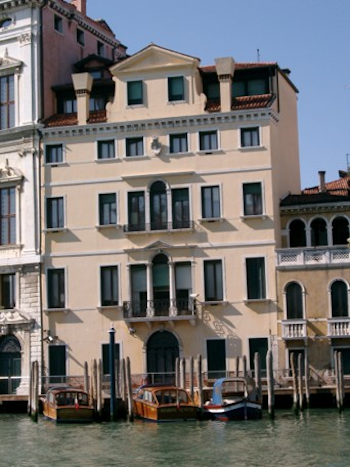
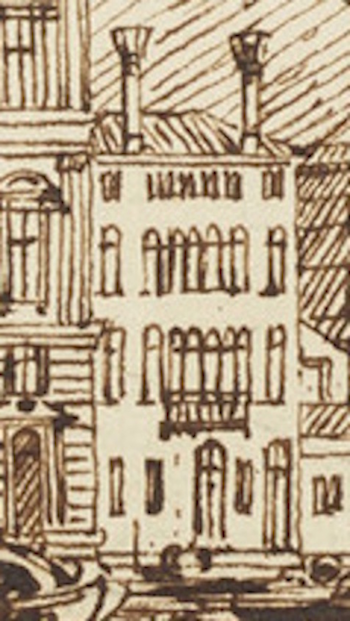
1.2 Yet, upon closer inspection, this lovely facade reveals a few things out of place. The “penthouse” windows that surround the dormer seem, in their very discreetness, to be of a later style; the tiny dormer perched to one side seems extraneous to the design. A quick look at an engraving by Luca Carlevarijs from 1703 (Fig. 3) and the sketch by Canaletto from 1734 (Fig. 4) readily confirms these suspicions: in fact, the top floor did not exist at all. Evidently, in Carlevarijs’s and Canaletto’s day, the chimneys were hexagonal and long, not short and square. Furthermore, all the windows on the middle two floors were once rounded, an arrangement that emphasized not the vertical symmetry of the facade, but rather its horizontal organization. In the Canaletto sketch and the Carlevarijs engraving, two impressive rows of seven identical, elongated, arched windows articulate the two main stories (piani nobili) and distinguish them from smaller square windows in the servants’ regions on the top and bottom floors. The design of the windows and balconies clarifies the location of the portego, a grand central hallway that is a classic component of a Venetian palace.
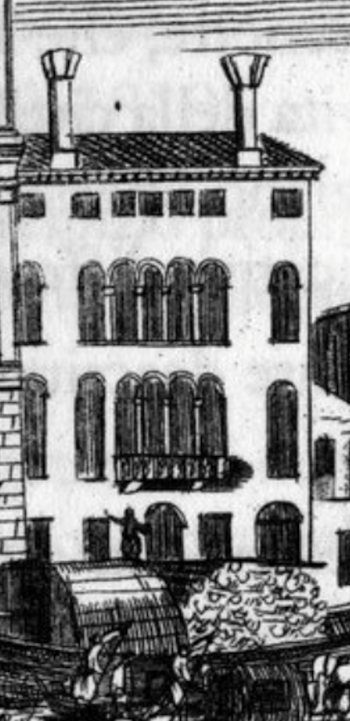
Fig. 3. Detail of an engraving by Luca Carlevarijs. Le Fabriche, e Vedute di Venetia (Venice: Gio. Battista Finazzi, 1703), 83.
1.3 Sneaking around to the back of this building is rather like going back in time (Fig. 5). The walls bear an earlier, reddish coat of paint, the central trio of windows has retained the rounded shape shown in Canaletto’s drawing, and in one spot there are only four stories instead of five. But changes have accrued here, too. Not only were the outer two windows on each floor squared off, but, curiously, one was shortened and the other shifted up half a story.
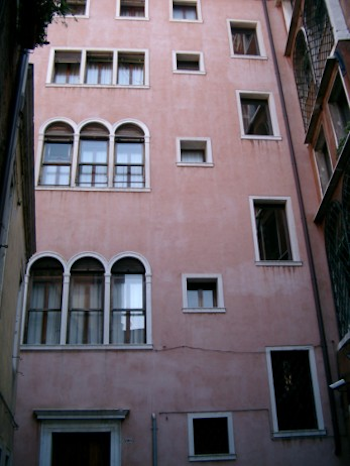
1.4 This building is the one where I believe Francesco Cavalli spent the last thirty years of his life—and where he composed most of the operas that helped make Venice the leading center of opera in the seventeenth century. The house was originally built by the Balbi family in the late sixteenth century as an adjunct (“casa contigua”) to their grand palace next door. But the facade was later altered to suit changing architectural styles.
1.5 In 1971 the building became part of the Palazzo Balbi office complex, headquarters of the regional government. To transform the house into office space, the wall adjoining the main palazzo was opened up and the staircase moved from the center to the rear corner.[3] This explains the strange alteration to the rear windows: they were moved to illuminate a newly added staircase.
1.6 The history of Cavalli’s house provides a marvelous analogy to the history of his operas—and to those of most other opera composers in the seventeenth and later centuries. As I have described in other publications, throughout their years on stage, Cavalli’s operas were normally altered by various people to suit different tastes and needs.[4] Some of the alterations (like those to the house’s windows) changed the opera’s overall aesthetic effect yet created a new kind of logic. Others achieved new goals—in the case of the house, for example, the security cameras trained on the front door. Most of the extant musical sources from this repertory are neatly copied manuscripts that, like the front of Cavalli’s house, conceal most traces of remodeling. But there do exist some sources that are more like the back of the house: messy, where we can see earlier layers.[5]
1.7 This analogy illustrates the ways in which physical artifacts—like buildings and opera scores—can testify to the processes of creation and alteration. Venice is the very embodiment of this concept: its famous decrepitude—the missing plaster, the incompletely realized renovations—allows its past to leak through to the present. If we peer behind the facade, if we explore the back alleys and eroded canal-fronts, we may be able to see fragments of earlier architectural layers.
1.8 We can do the same thing when studying seventeenth-century Venetian opera scores. There are rare messy manuscripts that allow us to track the changes that accrued in a live production. Then there are the neat manuscripts that were copied from the messy ones (after which the messy ones were discarded), which form the bulk of surviving seventeenth-century musical sources. One way of detecting what exemplars they were copied from is to look for errors, contradictions, and anomalies.
1.9 I’ll begin by presenting the case for identifying Cavalli’s house, then I’ll take you on a tour of the interior, as I’ve reconstructed it. After that I’ll zero in on what Cavalli did there in his career as an opera composer, focusing on the written documents that are our only record of how he hammered out his own operas and remodeled those of others. Then I will draw parallels with what I did when reconstructing Scipione Affricano.[6] Finally, I will take the reader on a tour of my own house in Grinnell, Iowa, expertly reconstructed, rounding out the architectural metaphor.
2. Identifying Cavalli’s House
2.1 By April 1646, Francesco and Maria Cavalli had rented a house on the Grand Canal that was to be their primary home until their deaths.[7] This information comes from the composer’s will:
Al Sig[nor] Angelo dall’ oglio mio Com[missari]o lascio, … li quattro quadretti di pittura di mano di mio fr[at]ello; quali si ritrovano in Camera della littiera s[opr]a Canal grande del p[rim]o Solaro.
(To Signor Angelo Dall’Oglio my executor I leave … the four little paintings by the hand of my brother that are in the bedroom above the Grand Canal on the first story.)[8]
We also know that Cavalli’s residence was near the church of S. Tomà in the parish of S. Pantalon:
A Maddalena da Crema mia serva … lascio il residuo delli mobili, tutti, saranno nella mia Casa à S. Tomà.
(To Maddalena from Crema, my maidservant, … I leave the residuum of all the furniture in my house at S. Tomà.)[9]
It is also well-known that he rented the house from the nobleman Sebastian Michiel, since Cavalli’s financial papers include several rental receipts:
[on the outside, in Cavalli’s handwriting]:
R[icevu]ta della Casa In Volta di Canal à S. Pantalon
[on the inside, in Michiel’s handwriting]:
Adi 8 Zen 1647: Ho recev[u]to io Seb Michiel dal Sr. Fr[ances]co Cavalli [per] nome del Col[endissi]mo Nicolo Balbi [per] haver casa in volta di Canal [per] mesi tre anticip[a]ti L cento sessanta sette co[nta]ti … val L 167:8(Receipt for the house at the bend in the canal at S. Pantalon
January 8, 1647 [m.v. = 1648]: I Sebastian Michiel, in the name of the most respected Nicolo Balbi, have received from Signor Francesco Cavalli for the house at the bend of the Canal for three months in advance, one hundred sixty-seven lire in coin, i.e. L. 167:8)[10]
2.2 When he moved in, Cavalli was forty-four years old and had enjoyed a moderately successful career as a church musician, rising through the ranks at S. Marco from choirboy to tenor, to second organist, to first organist. He had also been one of the first composers to engage with the new genre of Venetian public opera, which had been introduced only a few years earlier. Cavalli had composed nine operas by this point.
2.3 For Cavalli, taking a house on the Grand Canal, alongside the Venetian nobility, at a price that consumed well over half his annual salary from S. Marco, was a bold move.[11] But it is one that speaks loudly of his professional and social ambitions. By the time he died thirty years later, he had risen to the rank of maestro di cappella at S. Marco, one of the most important musical positions in Europe. He had written another two dozen operas that had not only helped establish Venice as the opera center of seventeenth-century Europe but had also helped initiate this new genre in cities throughout Italy. Cavalli’s fame had reached beyond Italy to England, Austria, and particularly France, and in 1660 he was commissioned to write an opera for the wedding of Louis XIV. Cavalli died a wealthy man: he had substantial property and investments. Although he did not own his house in Venice (only half of Venetian patricians owned their homes),[12] he did own a villa near the Brenta Canal in Gambarare, alongside the villas of countless other wealthy Venetians.[13]
2.4 In 2003 I was studying Cavalli’s papers and, coincidentally, living in an apartment in S. Tomà. I came across a letter addressed to Cavalli “at S. Tomà at the bridge over the Frascà[da],” which was only a block from where I lived.[14] From there I started investigating palaces on the Grand Canal and soon came across a book about Ca’ Balbi by art historian Elena Bassi.[15]
2.5 Bassi quoted the 1661 Redecima (tax) statement from Alvise Balbi, which asserted that half of his palace as well as the house next door were rented to Cavalli’s landlord, Sebastian Michiel:
In contra di S. Pantalon: Una casa sopra Canalgrande cioè il soler di sotto, et un’altra casa contigua posta appresso la detta tenuta ad affitto dal N H ser Sebastian Michiel mi paga d’affitto all’anno D.ti Seicento.
(In the parish of S. Pantalon: A house on the Grand Canal, that is the lower story [i.e. first piano nobile], and another contiguous house placed next to the first one, rented by the N. H. Ser Sebastian Michiel; he pays me rent of 600 ducats per year.)[16]
That led me to Michiel’s Redecima statement that claimed he was living in the palace proper and had sublet the “casa contigua” to Cavalli:
In contra di S. Pantalon, al ponte della Frescà, … casa abitata dal signor Francesco Cavalli organista di San Marco.
(In the parish of S. Pantalon, at the Ponte della Frescada …, the house inhabited by Francesco Cavalli, organist at S. Marco.)[17]
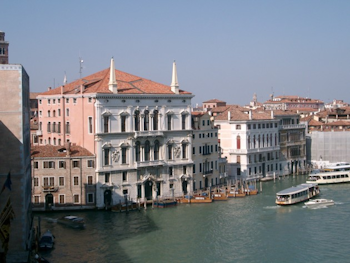
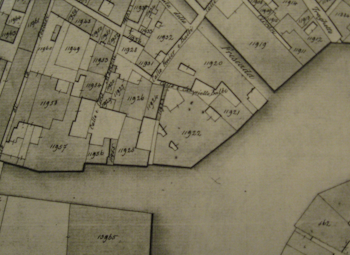
2.6 In point of fact, there are two houses contiguous to Ca’ Balbi: the brown house to the left (Palazzetto Masieri), and the yellow house to the right (Palazzetto Angaran-Caotorta) (Fig. 6). Don Gastone Vio, the noted archivist, believed that Cavalli lived in the Palazzetto Masieri; his evidence was the “Catasto Napoleonico” made in 1808, which shows both this house and Ca’ Balbi under a single number (Fig. 7).[18] But this map was made after the invasion of Napoleon, when a great deal of property ownership was “adjusted.” Besides, Palazzetto Masieri is not technically on the Grand Canal, but rather on the Rio Foscari, and further from the bridge over the Rio de la Frescada. Furthermore, the layout of the house described in Cavalli’s death inventory corresponds perfectly to the Palazzetto Angaran-Caotorta: the first piano nobile of Cavalli’s house had a portego and two rooms overlooking the Grand Canal plus a third room overlooking the alley at the back. This suits the L-shaped layout of the Palazzetto Angaran-Caotorta nicely. But the layout does not correspond at all to that of the Palazzetto Masieri, which is triangular: there is no place to put a central portego.
3. Inside Cavalli’s House: Primo Piano Nobile
3.1 The two main sources of information we can use to reconstruct the inside of Cavalli’s house on the Grand Canal are his will[19] and the household inventory made two days after his death (January 14, 1676) and completed the following day.[20] The inventory was made in the presence of his three executors (his former student Don [Giovanni] Zuanne Caliari and his friends Antonio Fustinoni and Angelo dall’Oglio); Alvise Bin, the steward of the convent of San Lorenzo (to which Cavalli left the residuum of his estate); and two witnesses (Jacobo Gritti and Francesco de Blancis). The inventory was presented to Cavalli’s notary, Domenico Garzoni Paulini. In Fig. 8, I have aligned the apparent floor plan of the Palazzetto Angaran-Caotorta with the rooms described in the inventory. See also App. 1, which is a transcription and translation of the inventory, and App. 2, which is a transcription and translation of his final will.
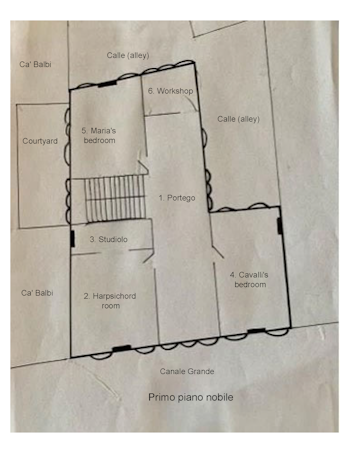
3.2 The executors began their tour of the house (on the second day of their inventory: App. 1, p. 3) by ascending the staircase to the first piano nobile and emerging into the portego (room no. 1). The portego was typically a room for impressing visitors. Traditionally, the portego had a polished terrazzo floor and a ceiling with travi (exposed beams).[21] The first thing the executors observed were the walls, which were clad in leather stamped with gold. This was a common feature in Venetian palaces; Cavalli had five rooms with leather wall hangings, of which three were described as stamped in gold.[22] The second thing they listed was the portrait of Cavalli, no doubt conspicuously placed at the head of the staircase according to Venetian custom; as well as the portrait of Maria’s uncle, Bishop Claudio Sozomeno (both are apparently lost). The portego was usually something of an art gallery. Cavalli had seven paintings here, including one of the rape of Lucretia, one of the story of Cain and Abel, and two ladies and one child (anonymous portraits). This room also contained a harpsichord, evidently the one with a keyboard decorated in ivory, with lid paintings by his late brother,[23] which he willed to his student Fiorenza Grimani, a nun at S. Lorenzo. Seating was provided by eight chairs “of Russian leather, with knobs and studs [of brass],” and there was a small table. Four curtains of red cloth sealed off drafts from the staircase. The most curious thing in the portego is a “homo di legno,” which art historian Patricia Fortini Brown describes as a wooden manikin.[24] This was for sewing, perhaps for work on opera costumes.
3.3 Room no. 2 on Fig. 8, the “Harpsichord Room,” was presumably intended for entertaining family and visitors; Cavalli surely also used it for professional purposes, such as giving music lessons and conducting rehearsals. Cavalli’s harpsichord room was lavishly decorated, with white leather wall hangings. There were nine paintings—including St. Cecilia, a Madonna and Child with St. Joseph, an icon,[25] a nude Venus, an anonymous portrait, three still lifes, and an image in relief—and a mirror. He left the paintings to one of his executors, Antonio Fustinoni, except the S. Cecilia which he willed to another of his nun students at S. Lorenzo, Betta Mocenigo. The furniture included two inlaid side tables, another small table, and six chairs of Russian leather, three other chairs, and a couple of tiny walnut chests. The harpsichord was made by Donato Undei and had a keyboard of boxwood; he left this to the organ maker and caretaker of organs at S. Marco, Francesco Magini.
3.4 Adjoining this room was a “studiolo” (no. 3), whose only contents was an “armoire with various shelves,” full of bound volumes and music manuscripts. This room is best described as Cavalli’s personal library, perhaps displayed for the benefit of visitors. This was surely the location of the beautifully copied versions of his operas “bound in red leather and embossed in gold” mentioned in his will; these correspond to thirteen scores in the Contarini Collection at the Biblioteca Marciana in Venice today.[26] The library must also have included his various sacred publications, plus any music by other people he had collected. Cavalli willed all his musical scores, including “operas, chamber, and church music” to his executor Caliari, a singer who had studied and worked with Cavalli for over twenty years—except the opera scores bound in red leather. (Regardless, all the surviving opera scores were purchased by Marco Contarini, except two which are in the Österreichische Nationalbibliothek in Vienna.)
3.5 Crossing the portego, the executors came to no. 4 on Fig. 8, Cavalli’s bedroom overlooking the Grand Canal. This room was dominated by a bed decked out in high Venetian style: the iron frame was gilded and decorated with figures of lions, the bed had a canopy of red and yellow brocade, and there was a coverlet with crimson designs and elaborate trim. There were also leather wall hangings and six religious paintings. Four were painted by his brother, as we learn from his will; these he left to his executor Dall’Oglio. There were four chairs, a small table, and a prie-dieu for private devotion. The fireplace was furnished with a satin hearth screen, a bed warmer, and fire tools. There were two chests in this room, containing clothes and bed linens. Another chest contained his valuables: among them was a silver gilt goblet in the shape of an ostrich that was given to him by Archduke Ferdinard Karl (as we learn from his will) when Cavalli stopped in Innsbruck on his way to or from France in 1660 or 1662. Other valuable items are two silver saucers and a silver fruit basket bearing the Cavalli coat of arms (which he describes as “la mia arma”),[27] plus three silver fruit baskets, another silver saucer, two silver forks and spoons, and a silver salt cellar. Cavalli distributed most of the silver to his friends in his will. He also came into possession of a half-sack of uncut rubies in a court case; these were apparently sold.[28]
3.6 The executors then moved on to no. 5, the second bedroom. This room was initially occupied by Cavalli’s wife Maria, as the trunk of “old” women’s clothes suggests. Although Maria had died twenty-four years before this inventory was made, and in her will she instructed her husband to sell her clothes, Cavalli’s will states that he kept them. The room had leather wall hangings stamped in gold, a painting of the Madonna, and a mirror. There was also a bed, a small table, three comb cases, six small brocade chairs, and two rush-bottomed chairs, which Patricia Fortini Brown says were specific to women.[29] By 1657 Cavalli’s two sisters, Cecilia (1610–1662) and Diambra Caterina (1614–1663) had come to live in the house at S. Tomà with Maddalena, their servant from Crema. Perhaps they occupied this room (or bedrooms on the second piano nobile).
3.7 Finally, with no. 6, the little study adjoining this room, we come to the heart of the enterprise: this is the room I am calling Cavalli’s “workshop.” (Note that the author of the inventory uses the phrase “studiolo contiguo”—small adjoining study—for both the workshop and the library, nos. 6 and 3. See App. 1, pp. 3 and 5.) This room was outfitted with a full-sized table (the only one in the house), two chairs, a cabinet with sheets of music, a basin and pitcher, and something that looks very much like an inkwell. Although there is no harpsichord, there is one nearby in the portego. We can glean one further detail about the workshop from Cavalli’s will: he describes his study as “the new room facing the alley.” This language suggests that Cavalli did some remodeling on his rented house, creating a new room to suit his working habits. On the floor plan, I have proposed that he simply walled off the far end of the portego, creating a workroom with ample sunlight.
3.8 In his will Cavalli describes the second bedroom, complete with bed, mirror, etc., as “my study” (mio studiolo). This terminology suggests a certain link between the bedroom and the business of the workshop proper. Such an arrangement is likely: Cavalli’s wife Maria was his principal copyist until her death in 1652 and taught his students the basics of music copying.[30] The composer bequeathed the contents of this bedroom to his student and executor Caliari, who was one of his copyists (= P3).[31] We know that Caliari (ca. 1646–after 1693) lived in Cavalli’s house for many years (in his will Francesco says he “raised him”); perhaps he occupied this bedroom. The workshop would provide the perfect place for Caliari to fix up certain scores (Artemisia, Poppea) and supply composer attributions for ten scores prior to selling them to Contarini.
4. The Rest of the House
4.1 From there, the executors ascended to the second piano nobile and emerged into the portego. There they found eight paintings, including portraits of Maria Cavalli (lost), a Dogaressa, and a general, plus the story of Abel, the story of Lot, sea monsters, and two “antique” paintings. There was also a sordino (a type of quiet keyboard instrument, similar to a clavichord), made by Giacomo Zanetti.[32] This is perhaps the sordino that Cavalli mentions in his will that was owned by his friend Francesco Undeo, and was kept at Gambarare; perhaps he brought it back to S. Tomà before he died. There were also two tables, a writing box, an armoire for bed linens, four broken benches, and four chests containing shirts, underwear, bed and table linens, and one containing “things … for the use of the maid, Maddalena.” The other rooms on this floor were apparently empty.
4.2 Then the executors ascended to the servants’ quarters. There were two small bedrooms on this floor; the first was evidently Maddalena’s room because it contained a chest with her clothes. It also had a painting of the Nativity; other chests contained a black bautta and a cap of crimson velvet, plus a man’s outfit “for the country” (perhaps what Cavalli wore on his trips to his villa at Gambarare). The other bedroom might have been used by Francesco Canella, Cavalli’s manservant, but it did not contain his possessions because he was attending Cavalli at the Canonica (to be discussed presently in chapter 5). There was a chest with bed and table linens and two shirts. It is interesting that both bedrooms contained kitchen implements, indicative of servants’ use.
4.3 It is unclear whether the kitchen was on the top floor or the ground floor. According to Bassi, the kitchen was sometimes in the attic of seventeenth-century palaces, so as to be accessible by the servants, but it was more common for it to be on the ground floor.[33] There were two areas in the kitchen, one of which was called the “extension,” which seemed to be the main cooking area, with a tripod, hook, and spit for roasting. This kitchen was equipped with cooking vessels made of copper; other items (pails, a basin, candlesticks) were made of brass. Wooden furniture included a table, a dresser, a cabinet, a shelving unit, and a chest containing flour. Among the items the kitchen contained were two cages for chickens and “70 plates, both broken and good ones.”
4.4 The executors continued their tour of the ground floor, which had a boat entrance from the Grand Canal and two street entrances. In the entrance hall, there were a round table and seven painted benches. Then there were several storerooms, which contained flour, wine, wood and cardboard to burn, and a saddle (ready to take to Gambarare in a boat).
5. The Canonica
5.1 Cavalli actually died at the Canonica, the Chapterhouse of S. Marco, so his possessions there were inventoried first. Although these quarters were reserved for the maestro di cappella, they did not come furnished: Cavalli owned all the items at the Canonica. There were four rooms in this apartment, which was on the first floor: a main room (called a mezzanine), two bedrooms (one overlooking the courtyard, and the other overlooking the canal called the Rio di Palazzo), and a kitchen. The Canonica rooms had to be vacated so that the next maestro di cappella (Natale Monferrato) could move in, so a separate list of “Robbe tolte” (things removed) was prepared at a later date.[34]
5.2 The main room was decked out with 163 pieces of elaborate leather wall hangings stamped in gold. The walls had two paintings of the Madonna, a mirror, and a landscape over the door. There was a harpsichord made by Giacomo Zanetti, eight chairs of Russian leather with studs and knobs of brass, and three small tables. One was covered with a cloth; on top were two earthenware vases with bunches of cloth flowers. There were also two glass-fronted drawers containing fruit. On one of the tables was a small chest of walnut and worked leather.
5.3 Cavalli’s bedroom was the one overlooking the courtyard. It had a much simpler bed than the one at S. Tomà (two trestles with a plank and a mattress), two fir armchairs, a small inlaid table, a painted canvas hearth mat, an “ordinary” rug, and two copper engravings of the crucifixion. What interests us is the “bundle of papers of musical compositions,” apparently on the table, as well as a small trunk containing his legal papers. We also find a silk box containing Cavalli’s prize possession: a diamond ring given to him by Louis XIV when he was in France (as we learn from the inventory). The central diamond was in the shape of a heart, framed by six other diamonds.
5.4 The other bedroom was probably occupied by his manservant, Francesco Canella. It contained a bed and two large walnut chests. In one of them was Cavalli’s clothes, including a fox fur coat, with an exterior of gold cloth, his toga (for official functions),[35] his surplice with lace trim (for services at S. Marco), and “a red undergarment lined in soft leather.” This chest also contained a silver saucer and a knife box with seven knives and three silver forks and spoons. The other chest contained bed linens.
5.5 The kitchen contained twelve maiolica plates, a table, an armoire, and various kitchen implements. There was also a mattress on the floor for the cook to sleep by the fireplace.
6. Gambarare
6.1 The villa at Gambarare was presumably inventoried, but the documents are not in the S. Lorenzo files (our main source of financial and legal information about Cavalli).[36] According to Cavalli’s will, two properties—(1) the Gambarare villa (“la casa grande dominicale”), garden, walled orchard, courtyard, oven, house of the renter, house of the steward, which he inherited from Maria (and the income from them); and (2) the property he purchased from Francesco Rota in 1655 (and the income from it)—would go first to his executors and his manservant Canella (for four years) and then pass to Zuanne Cavalli, son of the late Ferigo Cavalli, who brought Francesco to Venice and allowed him to adopt his name and coat of arms. Once the male line of the noble Cavalli family had died out, the property would revert to the nuns of S. Lorenzo (this happened in 1730).
6.2 Cavalli bought land near Gambarare throughout his life, starting in 1638. He had six pieces of land with houses at the time of the Redecima (1661: see par. 2.5), including the two properties mentioned above. He returned from France in 1662 and continued buying properties (seven) up to a few months before he died. He bought (on behalf of Angelo Dall’Oglio and in his name) two cottages and land contiguous to his estate at Gambarare; he explicitly left them to Dall’Oglio. He left another two cottages to Giovanni Caliari’s brother. He left the Pontin estate to his notary, Claudio Paulini, who refrained from ever billing him. Cavalli bequeathed his father’s house in Crema to a cousin and some land (and the income from the land) to his sister’s brother-in-law.
6.3 He provided for the musicians at S. Marco by instituting first a requiem composed by his successor, then every six months “in perpetuity” a requiem composed by himself, alternately at S. Marco and S. Lorenzo.[37] He also provided for mansonarie, that is a Mass said for his soul daily (officiated by Don Giovanni Caliari), and one for Maria (weekly, officiated by Don Lorenzo Rossi), “in perpetuity.”[38]
6.4 He returned from France with a lot of money. Starting in November 1662, he had invested D. 3500 at the Cecca (at 7%, which at the time of his death amounted to D. 5337:12) and D. 1600 at the Sal (at 6%) that would pay about double the amount for the mansonarie. At the Canonica, he died with D. 100 in cash, which he said could pay for funeral expenses.
7. The Workshop
7.1 All the surviving scores of Cavalli’s operas that we can directly link to the composer were copied in this house at S. Tomà: the twenty-eight scores at the Biblioteca Marciana and two at the Österreichische Nationalbibliothek. The seven that involve Maria Cavalli or her students can be dated from 1649 to her death, on September 16, 1652. Then there were the group copied after Maria’s death but before Cavalli returned from France in 1662. These are messy scores: manuscripts that are either autographs or production scores, where we can see reworkings and revisions (some more than others). For instance, we can see how Cavalli and his team responded to the death of the lead castrato in Calisto, by transposing and rewriting the part for a soprano. After Maria’s death, Francesco increasingly used autographs as production copies. Hendrik Schulze has written eloquently about the transformations in the Artemisia and Xerse scores.[39]
7.2 Cavalli eventually conceived of the idea of having his operas recopied by professional copyists, with ornamental calligraphy, and bound in red leather embossed with gold; these were the thirteen volumes that I suspect were on display in the “library” off the harpsichord room. There may have been more “red scores,” but since they were not purchased by Marco Contarini, they are lost to us.
7.3 The first opera that Cavalli composed in the house at S. Tomà was Giasone, his most successful and widely performed opera. After that point, he composed another twenty-two operas, plus his adaptations for revivals of two operas by him (Xerse and Erismena) and two operas not by him (L’incoronazione di Poppea and Ciro). Then there were all the sacred works he composed (collected in Musiche Sacrae of 1656 and a few other publications, plus various manuscripts) and a few chamber works. Together these compositions must have generated thousands of pages created in this workshop: autograph composing scores, production scores, and innumerable instrumental and vocal parts. The preparation of these scores and parts required a dedicated team of workers, constantly responding to changes during rehearsals and performances.
8. Epilogue: Architectural Parallels
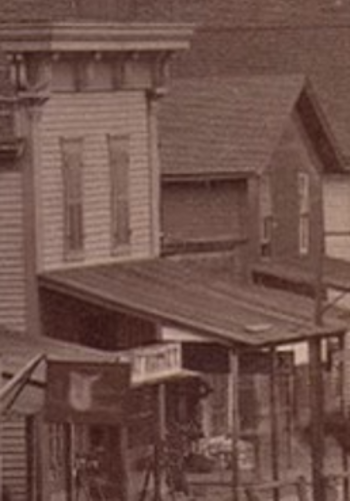
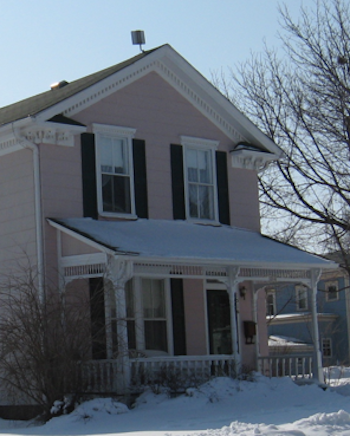
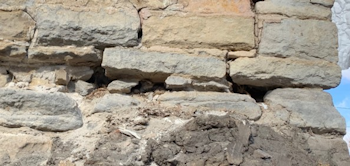
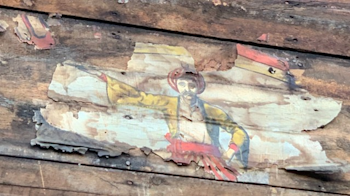
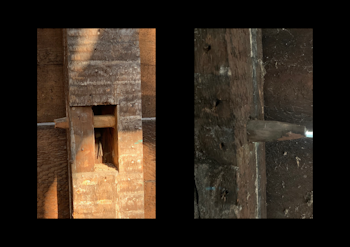
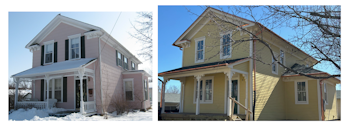
8.1 The house that I live in now recently underwent historical reconstruction. It was built in 1865 as a business in downtown Grinnell, Iowa (first a grocery store, then a real estate firm, and finally a hardware store with a tin shop on the second story); see Fig. 9 and Fig. 10.[40] It was moved to my land in 1893 after a series of fires downtown. In the process of deconstructing the house, we found evidence of wood rot, termite damage, wasp and hornet infestations, lead paint and lead water pipes, asbestos, and a crumbling foundation (Fig. 11). We also discovered a circus poster that took up the entire exterior side of the house (Fig. 12), newspapers from 1865 (attesting to the age of the house), and posts for ropes to bind the house together during the move (Fig. 13). After the house was moved, a front porch was added as well as a small addition to extend the living room, the staircase was changed, and the roofline was redone.
8.2 The process of deconstructing and reconstructing my house parallels the deconstruction and reconstruction I recently performed on Cavalli’s Scipione Affricano: the architectural metaphor that I began this essay with resonates loudly.[41] Although Cavalli’s score of Scipione is a neat, professionally copied manuscript (like the front of the composer’s house), I found at least three stages of work (two aborted premieres and the actual premiere). I also found many earlier layers of working, revisions, and transposition. I attempted a reconstruction of the earlier versions.[42]
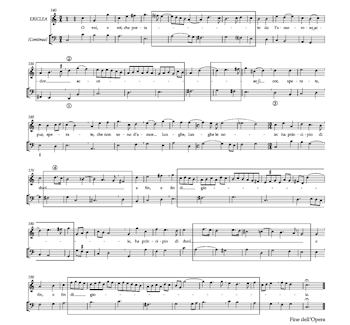
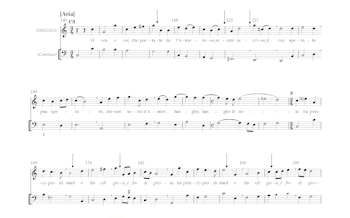
8.3 For instance, compare the final aria of the opera, Ex.1 (the manuscript version) with Ex. 2 (my reconstruction). I suspect that the impresario, at the insistence of the prima donna Giulia Masotti, agreed to let her add some “passaggi and happy things” to the composer’s version, and that Cavalli, “to avoid squabbles, [did] everything that [the impresario] order[ed].”[43] Furthermore, the libretto calls for a choral reprise at the end of the opera. But in Ex. 1, the writing is so florid that a chorus would have trouble repeating it. According to Beth Glixon, Scipione Affricano is the first instance of an opera ending with an aria (and not an ensemble), which later became standard in Venetian operas.[44] I maintain that removing the “passaggi and happy things” (all 30 measures worth in a 60-measure aria, marked here with boxes and arrows) preserves Cavalli’s original taut phrase structure. In addition, a chorus would easily be able to sing the reprise (Ex. 2).
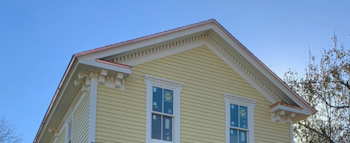
8.4 Some operatic revisions worked better than others. What is important here is that this manuscript is a living, breathing document that testifies to the many moving parts at work in an opera production, and how much cooperation is necessary to get the show up and running. The architectural metaphor continues, as my contractor has reconstructed the original dentil molding and corbels on my house (Fig. 14, and see Fig. 15 as well).
8.5 As we envision the Cavallis, both Francesco and Maria, their students, and professional scribes in their workshop, working away on various operas, we can almost hear the hammers pounding, conversation and disputes between architect and laborers, composer and singers. We can hear the operas taking shape, but fitfully, with many reversals and alterations in the original plans; we can see the workers tearing down walls and passages of recitative or adding porches and arias.
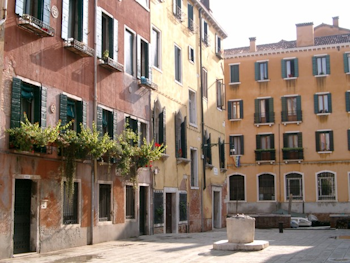
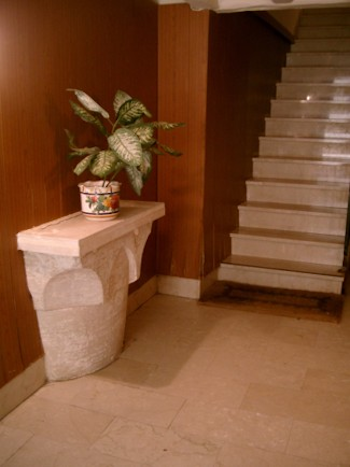
8.6 If we continue our walk around Venice, we can perceive a fantastic amalgamation of styles: Romanesque, Gothic, Neoclassical, etc. Along the way there was plenty of adaptation to new uses. A common feature of courtyards in Venice is a public well-head (Fig. 16). After the introduction of modern plumbing, some of the well-heads were converted to other uses, such as a place to put a plant (Fig. 17).
8.7 Yet in Venice the process of style change seems to have stopped somewhere in the nineteenth century. Frank Lloyd Wright’s plan in 1954 to remodel the brown house on the other side of the Ca’ Balbi (Palazzetto Masieri) came to naught after cries of outrage from traditionalists.[45] The parallels with opera history are obvious: sometime in the nineteenth century, a “standard operatic repertory” began to emerge that eventually came to dominate the world’s stages. Interest in newly composed operas declined; conversely, in the twentieth-century, interest in increasingly precise historical reconstruction blossomed.
Venice is a city whose very stones seem to embody two competing human impulses: the urge to adapt and the urge to preserve. These are two ways of interacting not only with buildings, but with the full range of artistic creations. As the proud owner of a series of historic homes, I am always disturbed that one of the leading indicators of economic health in the United States is “new housing starts.” But there was a time when “new opera starts” were an indicator of vigorous cultural activity in Venice. It is good to see that, in recent years, new operas are again leading the way.[46]
Acknowledgments
I thank Beth and Jonathan Glixon for their expert suggestions and assistance at a time when the author was no longer available.—Ed.
Appendices
App. 1. Cavalli’s Estate Inventory. Venice, Archivio di Stato, Archivio S. Lorenzo, b. 23, no. 16 (E).
App. 2. Cavalli’s Final Will and Testament. Venice, Archivio de Stato, Testamenti di Notaio Garzoni Paulini Domenico, b. 488, no. 206.
Examples
Ex. 1. Francesco Cavalli, Scipione Affricano, ed. Jennifer Williams Brown and Sara Elisa Stangalino (Kassel: Bärenreiter Verlag, 2022), LIV: final aria. Reproduced by permission.
Ex. 2. Francesco Cavalli, Scipione Affricano, ed. Jennifer Williams Brown and Sara Elisa Stangalino (Kassel: Bärenreiter Verlag, 2022), 200–1: reconstruction of the original ending. Reproduced by permission.
Figures
Photographs without attribution were taken by the author.
Fig. 1. Giovanni Antonio Canal (Canaletto), “Venice: The lower bend of the Grand Canal, looking north c. 1734.” Pen-and-ink drawing. © Royal Collection Enterprises Limited 2025 | Royal Collection Trust. Reproduced by permission.
Fig. 2. Palazzetto Angaran-Caotorta
Fig. 3. Detail of an engraving by Luca Carlevarijs. Le Fabriche, e Vedute di Venetia (Venice: Gio. Battista Finazzi, 1703), 83.
Fig. 4. Detail of the drawing by Canaletto shown in Fig. 1
Fig. 5. The back of the house
Fig. 6. Left to right: Palazzetto Masieri, Ca’ Balbi, and Palazzetto Angaran-Caotorta
Fig. 7. Location of Palazzetto Masieri and Ca’ Balbi (no. 11,922), and Palazzetto Angaran-Caotorta (no. 11,921), as mapped in 1808. Archivio di Stato di Venezia, Catasto Napoleonico: Mappa della città di Venezia (Venice: Marsilio, 1988), 18.
Fig. 8. Reconstruction of the first floor (primo piano nobile) of Cavalli’s house, based on the inventory
Fig. 9. Nineteenth-century photo of my house downtown: half of a stereopticon set owned by Byron Hueftle-Worley
Fig. 10. My house at its current address, before reconstruction
Fig. 11. Crumbling foundation
Fig. 12. Circus poster
Fig. 13. Posts to bind the house during the move from downtown
Fig. 14. Reconstruction of corbels and dentil molding on my house
Fig. 15. My house as reconstructed: before (left) and after (right)
Fig. 16. A well-head in Venice
Fig. 17. A new use for a well-head in Venice